Dersu Uzala
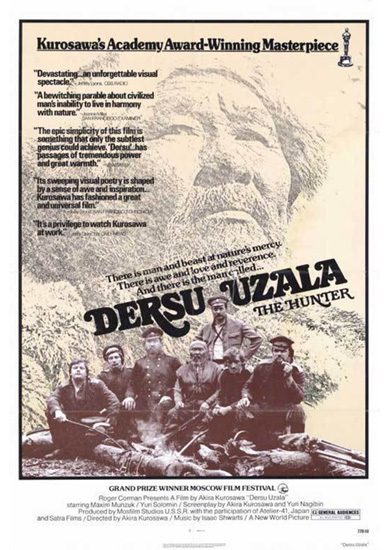
The Russian army sends an explorer on an expedition to the snowy Siberian wilderness where he makes friends with a seasoned local hunter. They develop a deep and respectful friendship.
Film Notes
In the early 1970s Akira Kurosawa's fortunes and spirit were at a low ebb. He'd been dropped by Hollywood from the Pearl Harbor epic Tora! Tora! Tora! in which he had invested much time and energy. His first colour film Dodes'ka-den was a critical and box-office failure. A crisis in the Japanese film industry had made financing his movies impossible. As a result he attempted suicide. But eventually his career was restored by a Soviet invitation to direct a film version of a non-fiction work he'd loved in his youth, and back in the 1940s he had planned a Japanese version that was aborted, partly due to unsuitable locations but mainly because its themes were in conflict with Japanese militarism. Published in 1923, the book is a memoir by the Russian army engineer Captain Vladimir Arsenyev about his friendship with a nomadic hunter, Dersu Uzala, of the remote Nanai tribe, known at the time as the Goldi people. Uzala twice saved Arsenyev's life while acting as a guide to his surveying expedition in remote eastern Siberia during the first years of the 20th century, the first time in a blizzard, the second after an accident on a raft in a fast-flowing river.
Shot on location over a period of nine months, it's an elegiac film of great visual and spiritual beauty about the relationship between an intelligent European raised in an advanced urban world (the tall, handsome Yuri Solomin), and a wise, nomadic Asian in close touch with the wilderness (the stocky, elderly Maxim Munzuk). Both actors are excellent.
This humanist masterwork is close in spirit to John Ford and has many of the ingredients of a classic western. The central relationship recalls that between the pioneers and the native Americans in the novels of James Fenimore Cooper, though the violent incidents happen offstage. The film won an Oscar for best foreign language film, and Kurosawa went on to make Kagemusha, Ran and Dreams with backing from Lucas, Spielberg and Coppola.
Philip French, The Observer, Sun 8 Jan 2012
WHEN Akira Kurosawa, the gifted Japanese director, takes the unusual step of making a movie in coproduction with the Soviet film industry and when the first half is delicate and haunting and the second half is numb and ponderous, it is hard not to jump to conclusions about who did what.
“Dersu Uzale" was shown at the 1976 New York Film Festival. The following review by Richard Eder appeared Oct 5, 1976.
Essentially, “Dersu Uzala” is a Tolstonyan parable about the encounter of the blind and deaf power of civilizetion with the perceiving and magical helplessness of nature. Set in the Asian forests of Imperial Russia around the turn of the century, it tells of the relationship between a military mapping expedition and an old Tungus trapper who acts as its guide.
“Fire is a man,” he tells them. “Water is a man, too.” The captain, a sensitive intermediary between the brutal confidence of the soldier-surveyors and the mystical trapper, hires him as guide. In a series of episodes, told flatly and some with obviousness, but with accumulating force, we see Dersu, through the captain's eyes, reveal his total communication with the world he lives in.
Seeing footprints, he knows that men have been by two days before, end that they are Chinese. Seeing trees with the bark off, he predicts that they will find a shelter, and they do. When the party is about to leave the shelter, he insists on repairing the roof first: for anyone else who may come along.
Dersu, marvelously played by Maxim Munzzuk, a Soviet Asian, draws his wisdom from his complete openness to the natural world. The openness means vulnerability as well. The captain, whose relation to the old man is a growing reverence, discovers him one night, broken with grief by the fire. He is remembering his family, dead of smallpox; and he has no barriers against remembered painâ€it is as real as a tree falling upon him.
In the climactic scene of this first part, Dersu and the captain go out to chart a frozen lake. Kurosawa films the cold as it has rarely, if ever, been filmed. It is a visible, redâ€eyed enemy, visibly terrifying. The two are lost and Dersu, seeing death,- is in total fear. The captain has his civilized schooling to constrain him; he also has a compass. When the compass fails, though, Dersu saves them both.
Then this beautiful first part recedes. The detachment prepares to return to the city. Dersu declines the captain's offer to come with them. He would die in the city, he says, but as he trudges off through the snow we see he is older and is simply following his own road to death. The soldiers march down a railroad track, singing; Dersu reach the top of a hill. Just before he crosses, he turns and waves. “Dersul” the captain cries. “Captain!” Dersu calls back.
It is complete, or should be. If “Dersu Uzala” ended there it would be an odd marvel. But it goes on, repeating the cycle. The captain returns some years later, this time in the summer. He meets Dersu, who displays his powers once more, but with diminishing effect. He has grown too old for the forest; finally he goes to the city with the captain, can't adapt to it, and returns to the forest for the last time.
The episodes in this second part go on endlessly, loosely, obviously. They lack the revelations of the winter scenes and they do little but belabor at length the points already made. They wreck the film's balance and make its achievements dull.
Richard Eder, New York Times, October 5th 1976
What you thought about Dersu Uzala
Film Responses
| Excellent | Good | Average | Poor | Very Poor |
|---|---|---|---|---|
| 17 (39%) | 25 (57%) | 2 (5%) | 0 (0%) | 0 (0%) |
|
Total Number of Responses: 44 Film Score (0-5): 4.34 |
||||
Collated Response Comments
87 members and guests attended this screening. We received 44 responses giving a film score of 4.34 and a response rate of 51%. Thanks so much for taking the time. All of your comments are gathered below.
“Touching in so many ways. Wonderful acting. Didn’t seem as if Dersu was an actor…but a real person. His smile lit the world, his sadness and being in the wrong place was heart-rending. And what atrocious environment to film in”.
“Hasn't inspired me to visit Siberia, but beautifully filmed and an intriguing plot, if a little implausible at times. Quite slow-moving in the middle but an interesting reflection on how hard it is to adapt to life in an alien environment”.
“I really enjoyed this film, although maybe the second half was a little too long. Strong performances from the Captain and Dersu. The pair being lost at the frozen lake scene was particularly moving. Dersu might be seen as an outsider but he had the wisest words about our environment”.
“Yet again Kurosawa gives a visual spectacle, outstanding photography, a direction finely tuned to nature and a striking performance from Munzuck playing Dersu. Liked the contrast between the 'character' of the natural environment and that of human nature. Maybe a cliché to note this as a paeon to mother nature. Dersu is in harmony with the powerful wilderness, with honed survival skills that he communicates well to Arseniev, then his mapping troop who realise that without this knowledgeable man they would die. The scene of grass cutting, using a theodolite stand and ropes, for a shelter, then the river rescue does give a "boys own" feel yet not a gung-ho masculinity. Hunting the hunters (a subtle swipe at the Chinese?) who kill for killings sake, reflects on Dersu mistakenly shooting a tiger. He fears the revenge of the land in which he has thrived for so long. Essentially a story about friendship, loyalty, love and respect between two men whose cultures could have clashed. In the end Dersu returns to the earth, yet almost peremptorily. One scene stays with me: Dersu and Arseniev standing at the centre of the frame with the sun on one side and the moon on the other. Despite the limited film stock, a good quality print for a 'big' movie”.
“Wonderful scenery and lovely birdsong. Loved the grass collecting scene, very dramatic”.
“Was concerned a 2 plus hour Russian based film might drag on, but was pleased this wasn't the case. A touching story of the bond formed by the hunter and the captain, both of whom showed great humanity. Felt real tension in the grass gathering scene and the cold and hardship of the region was tangible. While I can see it could have been cut to a much shorter film there was always enough to keep your interest. A different choice but the diversity of films is always enjoyable. Thanks”.
“Really enjoyed the biography of Dersu Uzala the hunter and the strong bond of friendship with Captain Vladimir Arsenyev the Russian explorer that grew through Dersu's knowledge of survival in the wilderness of Siberia. The energy of nature was strongly portrayed and observed”.
“A Beautiful film”. “Very sweet film”.
“Wonderful story. Excellent scenery”. “Superb”. “Wonderful”.
“The sound effects were astounding. That crunchy snow!”
“What a brilliant film, emotionally straight forward, the struggle for survival by mutual support and cooperation”.
“Magnificent film. Amazing photography. Thank you”.
“Beautiful film and very moving”.
“Beautifully shot and the music was very good. The film was a bit slow though! I did enjoy it”.
“Beautiful, but for me a little long”.
“Very moving. True friendship in harsh conditions”.
“First section was great. Second half not as well produced and engaging”.
“Enjoyed it but rather too extended at times for me. Could have been a bit shorter”.
“A bit long winded but probably needed to create the atmosphere”.
“A little slow to get going, but quite enthralling and atmospheric”.
“Amazing photography of weather conditions. Very poignant”.
“I did get to like it. I found the second half more enjoyable. Got used to the long slow scenes, perhaps”.
“Beautiful photography. Meditative”.
“Very interesting but slow”. “Slow and atmospheric”.
“Epic – best thing since Zhivago”.
“Great actors. Sad ending. Went on too long!!!”
What is F-Rated?
The F-Rating is applied to all films which are:
- Directed by women
- Written by women
- Has one or more significant women on screen

If it qualifies with one of the above it gets the Bronze rating.

If it qualifies with two of the above it gets the Silver rating.

If it qualifies with all three of the above it gets the Gold rating.
What is F-Rated?
The F-Rating is applied to all films which are:
- Directed by women
- Written by women
- Has one or more significant women on screen
If it qualifies with one of the above it gets the Bronze rating.
If it qualifies with two of the above it gets the Silver rating.
If it qualifies with all three of the above it gets the Gold rating.