Monster
A mother demands answers from her son's teacher when her son begins acting strangely. As the story unfolds through the eyes of the mother, teacher and child, the truth gradually emerges.
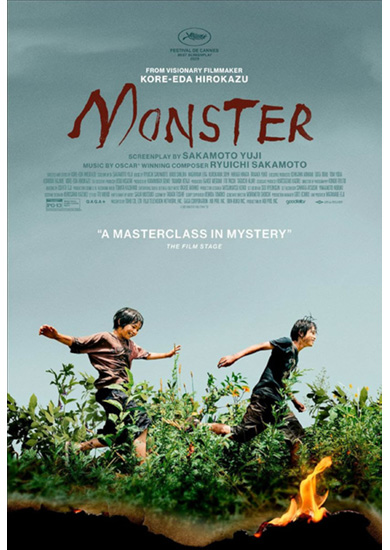
Film Notes
Monster: Koreeda Hirokazu’s elegant and imaginative expression of childhood
An incident involving a schoolboy plays out from three different vantage points in this finely-grained family drama.
An incident of classroom misconduct – and its ramifications, both domestic and institutional – plays out from three different vantage points in Monster. ‘Perspectives’ wouldn’t quite be the right term: though each section of Koreeda Hirokazu’s elegantly folded new film leads with a different character, the action is never shown explicitly through anyone’s eyes. Reverse angles and newly adjacent, contextualising scenes shift our conception of blame and victimhood in a story that narrows from one of a hostile community to intimate, ecstatic isolation.
Rashomon (1950) has been raised repeatedly by critics as a reference point since Monster premiered at Cannes last year, but it’s hardly the same. Koreeda’s film doesn’t pit contradicting stories against each other; rather, it layers accounts fraught with blind spots and psychological frailties – building a bigger picture while stressing everyone’s essential unknowability. At Cannes, Monster won the Queer Palme for the best LGBTQ+ story; it’s indicative of the film’s lithe, shimmying structure that viewers may spend the bulk of its running time mystified as to why.
For Koreeda, the film marks both a homecoming – to Japanese cinema, after somewhat ungainly excursions to France (The Truth, 2019) and South Korea (Broker, 2022) – and a departure. It’s his first feature since his 1995 debut Maborosi that he hasn’t written, and while Sakamoto YÅ«ji’s elaborately diagrammatic screenplay plays to Koreeda’s strengths with its fine-grained family drama and empathetic focus on children, its narrative switches and reversals require more opacity and emotional reticence than is customary from his filmmaking.
It begins with a building ablaze on the squat skyline of a small, unspecified Japanese city; a freak rainstorm will bookend proceedings, the elements twice uncannily intervening in a story of human impulse and foible. On one floor of the burning block is a hostess bar supposedly frequented by mild-mannered primary school teacher Mr Hori (Nagayama Eita); some distance away, widowed single mother Saori (AndÅ Sakura, the marvellous star of Koreeda’s 2018 film Shoplifters) watches the inferno with morbid interest from her apartment balcony. Her pre-teen son Minato (Kurokawa Soya) is one of Hori’s students; his mother’s distaste for Hori’s rumoured extracurricular activities will soon factor into a tense bust-up with the school staff.
The hitherto gentle Minato has become sullen and unreadable – cutting his own hair, going awol in a storm drain, jumping from his mother’s moving car. When he comes home from school with a facial injury, saying Hori is responsible, Saori reads the teacher and oddly impassive headmistress Fushimi (Tanaka YÅ«ko) the riot act. She gets repeated deferential apologies, but no explanation; the script is sharp on how a culture of courtesy can impede candour.
After 45 minutes, we rewind to the beginning, with Hori’s knowledge of classroom dynamics recalibrating our perception of Minato’s behaviour. But the teacher’s outburst that Minato is a bully – and his smaller, feyer classmate Yori (Hiiragi Hinata) his target – doesn’t ring true either: the boys are friends, perhaps chastely more, with an understanding of each other that increasingly excludes their minders.
‘Who is the monster?’ is a recurring question in Koreeda’s film, vocalised by the boys in a taunting, sing-song chant, but essentially paraphrased by adult characters keen to divide the world into villains and victims. Fushimi’s strange, affectless manner stems from the recent death of her grandchild, in which she may have been culpable; Yori’s alcoholic single father (Nakamura ShidÅ) may be his real abuser, implanting a ludicrous lie in the boy’s mind – that his brain was transplanted with a pig’s – which ripples maliciously through the action.
Some may find this a lot of business to wade through to get to the film’s heart, crystallised in its final third: a naive, intensely pure romance of sorts between two grieving boys, exquisitely played by Hiiragi and Kurokawa. But the friction between adults’ rule-determined antagonism and the unbound emotional and imaginative expression of childhood is essential to the film’s payoff – ineffable tragedy rising into galloping, sunlit release.
Guy Lodge, Sight & Sound, 14 March 2024.
Monster review – multifaceted mystery from Hirokazu Kore-eda
The Japanese director of Shoplifters uses different takes on a single story to tell the fraught tale of two troubled boys
Afrazzled widowed mother, Saori (Sakura Andô), suspects that all is not well with her preteen son, Minato (Soya Kurokawa). The boy seems subdued and withdrawn; she catches him hacking inches from his mop of hair. He asks odd, troubling questions: if the brain of a pig was transplanted into a human, what would the resulting creature be, human or pig? Or some kind of monster? And then there are the injuries – an ear yanked so brutally that it bleeds; a livid facial bruise. Saori soon deduces that her son’s new teacher, Michitoshi Hori (Eita Nagayama), at his provincial Japanese elementary school, is responsible for her son’s brooding disquiet. She confronts the school principal (a confounding reflecting prism of a performance from veteran actor YÅ«ko Tanaka), but is frustrated by the school’s response: a suffocating blanket of meaningless apologies designed to stifle her complaints. Saori is understandably angry: her son, after all, is the victim of a cruel teacher.
Or is he? The latest film from Hirokazu Kore-eda (Shoplifters), and the first since 1995’s Maborosi that he didn’t also write or co-write (the screenplay is by YÅ«ji Sakamoto), rewinds to the beginning of the story – a burning building is a marker point – and replays key scenes, fleshing out the tale, this time from the perspective of the well-meaning teacher. Hori feels, perhaps fairly, that he is being thrown to the wolves by the school authorities (“What actually happened does not matter,” says the chillingly dispassionate headteacher). His view of the classroom dynamic is that Minato is a bully who has systematically targeted a smaller, weirder child, Yori (Hinata Hiiragi), the social outcast of his class.
But then we rewind again, and the story plays out from the point of view of the two boys, showing the fragile new growth of a tentative friendship and the beginning of an understanding of deeper feelings for each other. The kind of feelings that Yori’s drunken, boorish father already suspects in his sensitive son, and is prepared to beat out of him.
It’s a difficult thing to pull off without it feeling a little disingenuous. This structure – the Rashomon technique of offering different perspectives on a single story, with each new angle subtly shifting the audience’s view – is by its nature manipulative. It only works when we, the viewers, accept that the film-maker is deliberately misleading us through selective omission and unreliable witness accounts; when we agree to be led astray and then guided toward some kind of truth and resolution.
Monster is an interesting case. Aided by a delicate, crystalline score by the late Ryuichi Sakamoto, Kore-eda deftly carries us through the shifting perspectives of the story with an ease born of extensive practice – the director of films such as Broker and Our Little Sister is no stranger to elegantly handled emotional manipulation, after all. There are a few too many red herrings, and some nagging questions. Why, for example, if the teacher suspected that Yori was being bullied by Minato, did he somehow fail to notice the campaign of terror being run by the other little shits in the class?
But when it comes to the payoff, that satisfying clincher that ties everything together, we are confronted with not one but two starkly contrasting readings of the ultimate “truth” at the end, one optimistic of a new start, the other involving the deaths of several characters. After the first viewing I veered emphatically towards the bleaker option. A rewatch opened up the possibility that the more hopeful take was the correct one. For what it’s worth, Kore-eda said after the film’s Cannes premiere that the cast and crew opted for the positive reading of events, but he conceded that the tragic interpretation was equally valid.
Does it matter that there is such ambiguity about the film’s ending? Perhaps not as much as you might expect, although there’s a sense that Monster pulls its punches throughout, forever stopping short of making a bold statement. The decision to focus on the relationship between pre-adolescents rather than older children is a key example – the film hints at questions of sexuality but neatly sidesteps actual sex. Ultimately, the question of what actually happened is just another red herring. The real point of the film is its heartfelt, if slightly trite, message: that it’s the wider world that needs to adapt and accept the differences of children like Minato and Yori, rather than the other way around.
Wendy Ide, The Observer, Sun 17 Mar 2024
What you thought about Monster
Film Responses
| Excellent | Good | Average | Poor | Very Poor |
|---|---|---|---|---|
| 024 (36%) | 30 (45%) | 11 (16%) | 02 (3%) | 0 (0%) |
|
Total Number of Responses: 67 Film Score (0-5): 4.13 |
||||
Collated Response Comments
112 members and guests attended this screening. We received 67 Responses delivering a film score of 4.13 and a response rate of 60%. Thank you so much for all of your comments and observation. They are all very much appreciated. All of your comments are collected below.
“The trick of showing the same sequence of events from different protagonists' point of view has serious precedent in Asian cinema - even shown at GFS; could this be some sort of homage? The actress playing the boy's mother was excellent, and the issues explored were worthy and serious. As in real life, there is often no "absolute truth", and no real answers. The issues are made more difficult to resolve by being set in the super-politeness of Japan, but the defensiveness of the administration and the unwillingness to sympathise and understand must ring bells in every organisation. All told, this was a good film - 2 hours well spent”.
“I see Koreeda had said that the boys came into themselves at the end when asked if the boys live or die? I'd hoped they survived! Enjoyed how the film keeps us guessing about who is the actual monster? Koreeda does so well in depicting complex flawed characters with such understanding. Maybe a low-stakes humanistic mystery but each character emerges in many ways; had to stop judging the characters without knowing the whole story. Thought how quickly the 'monster' changed with a slight alteration in from my viewpoint. So how familiar are the monsters that hurt us, for each one of these characters has their own pain and is the reason why someone else is in pain. Overbearing sense of helplessness of the kids who don't have much control over their lives. Real bullying evident, not brutal yet it makes the protagonists outcasts, with low self-esteem. Yori and Minato were individualistic yet familiar without knowing them properly. The queer angle in it blending perfectly with the theme of the movie: the confusion, denial along with childhood innocence and the mystery of "The pig brain". Blame everywhere; I started to blame the teacher, then the school leaders, the parents. Hori, Saori, Minato's stories overlap each other yet gaps between them may be difficult to overcome. The only thing they can do is keep trying to act as humans, not as monsters, with hope for the future. A truly fine film”.
“A clever technique to show two sides of the same story, but the plot was not credible in places. It was a sad reminder of how cruel children can be, both to each other and to others who are perceived as vulnerable”.
“Thanks again GFS for an interesting and entertaining film choice. I was on the edge of my seat. I liked the format of three perspectives. I decided that the boys went on to live happy lives”.
“Having watched Monsters I read the reviews to see if they shed any light on the unanswered questions the film posed, but they didn't really. Who started the fire? Did the children die in the storm and were reborn in the sunlight? Did the headmistress run over her grandchild? Did Hori throw himself off the roof? Still, an intriguing film which gradually exposed different truths but left a lot open ended. Thank for another stimulating choice”.
“’What actually happened does not matter' is the chilling suggestion from the head teacher here. A worrying thought for our post-truth world though it is perhaps the case here where perception is all and the truth a many facetted thing. An intelligent, balanced plea for compassion, understanding and communication and a warning against blindly clinging to etiquette and societal norms this folds the various versions of events neatly into each other like origami. The boys are the luminous centre of the piece, immensely subtle performances such young actors and Saori is warm and three dimensional, against which Hori is a trifle shrill. I'd prefer to see the ending as metaphorical; the boys having freed themselves of society's shackles and somewhere in the background Hori has climbed down from the roof. A commendably thoughtful piece of cinema”.
“The weak story line was blurred with emotions. I enjoyed the scenic views and the departmentalising of the story, very clever”.
“Brilliant. A film that will need to be processed. In turn uncomfortable, difficult, unexpected, sad, joyful. Impeccable cast and acting, in particular for the two main children’s characters”.
“Very drawn out, nicely filmed though”.
“I thoroughly enjoyed this brilliantly told and humanely nuanced story. Thank you for picking it”.
“What a journey! Really disturbing, but beautiful ending. Such an insight into ‘hidden truths’ in the educational Japanese culture”.
“Very clever, very sad. Beautiful film”,
“Disturbing, thought provoking, challenging”.
“Very interesting to see the story from different perspectives”.
“I didn’t want to know anything about the film beforehand! It was an unexpected story”.
“Excellent as always but not his best”. “Made a deep impact”.
“Thought provoking, complex and yet so simply told”. “Delightful”.
“A very captivating film”. “Very moving”.
“Powerful about self and identity – but family too ……..Terrible education system”.
“Too long, the two young boys seduced each other and the director”.
“I found this film very disturbing but interesting – the going back in time was intriguing”.
“Fascinating, multi layered, exhausting in equal measure”.
“Absorbing”. “Soo Japanese – loved it”.
“Confusing but engaging. Trying to understand”.
“Too long – I understood the concept but I was confused at times – especially as to the outcome”.
“Too complex for me”. “Confusing”. “A hard watch”.
“Clever how scenes were filmed from different perspectives”.
“Great young actors and actresses but complex boring story”.
“Understated story but not for me”.
“Tedious”.
What is F-Rated?
The F-Rating is applied to all films which are:
- Directed by women
- Written by women
- Has one or more significant women on screen

If it qualifies with one of the above it gets the Bronze rating.

If it qualifies with two of the above it gets the Silver rating.

If it qualifies with all three of the above it gets the Gold rating.
What is F-Rated?
The F-Rating is applied to all films which are:
- Directed by women
- Written by women
- Has one or more significant women on screen
If it qualifies with one of the above it gets the Bronze rating.
If it qualifies with two of the above it gets the Silver rating.
If it qualifies with all three of the above it gets the Gold rating.