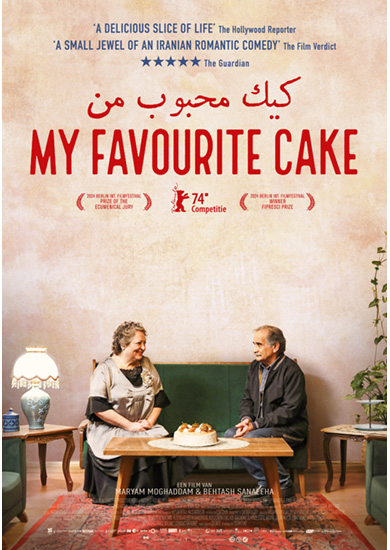
My Favourite Cake
Seventy-year-old Mahin, solitary until now, chooses to revive her love life. A chance encounter becomes an unforgettable evening.
What's this?
Film Notes
My Favourite Cake review – charming portrayal of a 70-year-old Iranian’s appetite for romance.
Heroine Mahin (Lily Farhadpour) is fiercely determined to revitalise her mundane existence and taste a better life.
As well as everything else, this wonderfully sweet and funny film will contribute to the debate about whether repressive regimes are the nursery of artistic greatness. The Iranian government has prevented the film’s two directors, Maryam Moghaddam and Behtash Sanaeeha, from travelling to Berlin to attend their own premiere; six months ago, their production offices were raided and computers and hard drives confiscated. But, fortunately, the film-makers had a copy stored in another country, and the film’s gentle humanity is a compelling rebuke to this fatuous, clumsy repression.
The authorities had apparently got wind of scenes in which women show their hair, and do not wear the hijab with enough modesty; the morality police drive around Tehran intimidating them with self-important purpose. The 70-year-old heroine – who wistfully remembers a time when hijabs were not required at all – stands up to these uniformed bullies and rescues a woman from their clutches.
This is Mahin (a lovely performance from Lili Farhadpour), whose story is a meditation on love and loss, loneliness and old age, and on the price at which long-term married happiness is bought. It is a meditation on how women come to terms with the destiny of widowhood, of knowing that they will almost certainly outlive their husbands. Mahin is herself a widow whose daughter and grandchildren live abroad, and her muted existence alone in her apartment is revealed in a series of tremendously composed tableaux. There are FaceTime phone calls with her daughter which somehow never allow for a proper talk. She has difficulty getting to sleep and doesn’t get up before noon. She waters the plants in her garden, goes shopping and occasionally hosts lunches for her female friends, at which the dominant theme is everyone’s various ailments, discussed at hilarious and explicit length.
But the conversation turns to whether it is possible to find romance again at their age. Why not? And so Mahin, without quite admitting it to herself, expands and modifies her aimless daytime schedule with a secret end in view: to meet a man. Mahin hangs out in the bakery queue, at the park, at a fancy hotel coffee shop and finally at a modest restaurant where pensioners’ food vouchers can be redeemed. And she finds herself meeting cute with Faramarz (Esmaeel Mehrabi), a modest, personable single man of her age. He is a cab driver and military veteran, who himself is of Mahin’s independent cast of mind: he got into trouble with joyless authorities for playing a musical instrument in a wedding band.
And so Faramarz and Mahin have their moment together at her apartment, where she offers to bake him her favourite cake. It is a moment of emotional connection for which they have saved up all their thoughts and feelings since becoming single – as if the entirety of their late-life inner existences are now being poured out to each other. There is something quietly magnificent in it. Moments like these in life are poignantly brief – but many never have them at all. It’s a lovely film.
Peter Bradshaw, The Guardian, 16 February 2024.
My Favourite Cake: an Iranian widow finds sweet rebellion in this gentle romantic comedy.
A 70-year-old widow in Tehran shakes up her predictable existence when she pursues a relationship with a lonely taxi driver in Maryam Moghaddam and Behtash Sanaeeha‘s defiant late-in-life romance.
After a long day, 70-year-old Mahin (Lily Farhadpour) is getting ready for bed. Preparing to brush her teeth, she appraises herself in the mirror. Squinting, she smudges turquoise eyeshadow over her eyelids. Better? Not quite. Sighing, she dots lipstick on to her cheekbones, rubbing it in with the back of her hands, and applying the coral to her lips. Her expression is sceptical, and then defeated. She retreats to the sofa, passing out in front of the TV.
A middle-class widow in Tehran who has spent the last 30 years single, Mahin’s day-to-day involves waking up at noon, watering her plants and throwing dinner parties for her girlfriends (“the old gals”). In the evenings, she watches romantic dramas and knits. As her friends tell her, over platters of watermelon, no man means no man to look after: it’s not a bad life. But it’s not an exciting one either, as Mahin flies under the radar, avoiding the watchful gaze of both the morality police and her neighbours.
Maryam Moghaddam and Behtash Sanaeeha’s gentle romantic comedy dares to ask if Mahin actually wants to move through life unnoticed. Frustration flashes across Farhadpour’s expressive face as her grown-up daughter tells her to wear her nice clothes “at home”. It’s a far cry from the plunging necklines and sky-high heels of her youth, which she describes nostalgically to a local cab driver. Mahin is wistful for an out-of-reach sexuality, knowing that it is also out of bounds. At the local bakery, she attempts to flirt with a stranger, moving in just that little bit too close.
She’s dismissed as a cuddly grandma, even as she muscles in to protect two young women in hijabs from a police officer. “You’d kill them over a few strands of hair?” she growls, as the young women cower, heavy fringe and pink hair peeking out from underneath their headscarves. Afterwards, one of the girls remarks that at Mahin’s age, that kind of sexism “doesn’t really affect you”.
Keenly aware of her dwindling sexual capital, and no longer accepting of it, Mahin takes herself to a pensioners’ cafe for lunch. It’s there she encounters taxi driver Faramarz (Esmaeil Mehrabi). When she overhears that he’s single and lives alone, she books a cab ride home with him, and strikes up a conversation. Emboldened by the pathetic fallacy (outside, summer rain pours) and Faramarz’s open, affable demeanour, Mahin invites him back to her place, where a romantic evening unfolds.
The film keeps pace with their date, Before Sunrise style, camera tightening as the conversation becomes more intimate. It’s only at this point – halfway through the film – that the couple reveal their ages. Possibly, Moghaddam and Sanaeeha withhold this fact in order to encourage audiences to work out how old they think these characters are. The divorced, twinkly-eyed Faramarz praises Mahin’s gumption, telling he knows that “women can propose too”. Over booze and peaches, Mahin begins to glow. They vow to make wine together, “like lovers do,” take selfies and dance, as the camera rotates around them. There is the sense that there is no more time to waste.
The film’s downbeat final stretch feels especially harsh, then, as Moghaddam and Sanaeeha burst their protagonist’s bubble.
The Iranian government has not supported the film, banning Moghaddam and Sanaeeha from travelling to Berlin for its premiere in February, and accusing the filmmakers of “crossing several red lines”, as Sanaeeha put it to the Hollywood Reporter, by depicting Mahin drinking alcohol and without her hijab.
What’s even more subversive, however, is Mahin’s sense of agency. Moghaddam and Sanaeeha frequently depict her alone at the centre of the frame, whether enjoying an affogato in a posh hotel lobby, waiting for a cab outside the market, or sitting at a park bench overlooking the city. In each setting, Mahin’s independence is presented as a fact rather than pitied.
Too often, later-in-life romances are presented as ‘cute’, neutered, shorn of sexual desire; here that desire is suggested, rather than shown. A scene in which the couple take a shower fully clothed risks reading as twee but in the event is simply tender, as they vulnerably acknowledge their long bouts of celibacy. There’s sensuality to be found elsewhere anyway, in Mahin’s night-blooming jasmine, and the promise of an orange blossom cake.
Simran Hans, Sight and Sound, 11 September 2024.
What you thought about My Favourite Cake
Film Responses
| Excellent | Good | Average | Poor | Very Poor |
|---|---|---|---|---|
| 34 (49%) | 31 (45%) | 4 (6%) | 0 (0%) | 0 (0%) |
|
Total Number of Responses: 69 Film Score (0-5): 4.43 |
||||
Collated Response Comments
120 members and guests attended this screening. We received 69 responses giving a Film Score of 4.43 and a response rate of 58%. Thanks so much for taking the time to let us know what you think. It is much appreciated. All of your comments are collected below.
“This had rather more to say and in more surprising ways than I was expecting. The first half, lightly drawn and nicely played gives us Mahin's life, her longing for a partner and the difficulties for a woman under the Iranian regime. There is then a change of tone as we enter... what? A fable, fairy tale or dream? An entire courtship occurs in a single night, the time frames skewed and action accelerated. There is something of both 'The Arabian Nights' and Shakespeare about it. At the end of which, we have to conclude, Faramarz (about whom there is something of Rumpelstiltskin) decides to exit having had a perfect evening, leaving Mahin bereft thinking she had entered a new paradise. The political comment throughout is obvious and didactic and one can only assume that this bitter finale is an extension of this: in Iran it is unwise to dare to dream. As beautiful as it is disheartening”.
“Delightful. orange blossom cake will never taste the same again. The poor ordinary people of Iran”.
“What a gem of a film. I loved the open and honest conversations between Mahin and Faramarz of their loves in life. But I was saddened by the ending. I wished they could have spent more time together”.
“My Favourite Cake obviously challenged the 'status quo' from Iran's strict Islamic government, where women have been subjugated. Mahin's actions - getting in the way of police trying to arrest young women for not having their hijabs on correctly and secretly using make up that would be frowned on outside - faces down those restrictions. Her rebellious character links to bigger struggles of the culture she lives in as the performance is bright in its nuance and emotional ability. She is visited by a jumble of female friends who talk wittily about polyps. The evident courage of the film makers (banned from leaving Iran) spreads through this charming film with universal themes: age, love, the social invisibility of older women. Gently, Mahin and Faramarz talk of time before the 1979 revolution remembering when sharing food and music would not bring police to your door. The levity in the film – showering fully clothed, infectious love via eating – is counteracted by its last ten minutes; is it divisive? In such a focused film, does the death and burial push too far? Yet it avoids sentimentality, in its display of perseverance and restrained pathos. A great example of how to keep the balance between hope and tragedy”.
“A brave endeavour to criticise the regime. Encouraging to see bodies that show signs of ageing and raised some interesting ethical dilemmas, though rather far-fetched at the end”.
“Horrendous to think what is currently going on in Tehran against the back drop of this gentle film. Highlights the fact that most people are ordinary souls wanting to get on with their lives and are not looking for the brutality of regimes or wars that are imposed upon them. Loved the lunch party and liked making the entire love story compacted into one evening rather than run over days, weeks or months. Another good and timely choice. Thanks”.
“A humorous, tender romance with an interesting view of life in Teheran and a surprising ending. Most enjoyable”.
“Inevitable end, but thoroughly enjoyable...”
“A most enjoyable film with a glimpse into the Iran lifestyle. I hope the Film Crew will be given the opportunity to create more humorous Iranian social history films”.
“Poignant portrayal of loneliness, tenderness and the inevitable denouement. Sensitive, well-constructed and absorbing”.
“Beautiful and sad – but also celebrates life”. “Lovely….!”.
“A charming bitter sweet film”.
“Are seat belts forbidden in Iran? A bit far-fetched!!”
“So sad but joyful. Excellent camera use”.
“I’ve never seen an Iranian film before. Thank you for broadening my horizons”.
“Great film and very moving in the current environment”.
“Bitter sweet. The humanity shone through the entire film and contrasts with the brutality of the authorities”.
“Topical. A very sensitive film”. “Very appropriate at this time”.
“Heartwarming, realistic and very appropriate”.
“Sensitive and courageous; a privilege to peek into the lives of others mixed with love, joy and humour”.
“Interesting insight into another culture. Love that they did that with so much humour”.
“Great to see that humour can transcend different cultures”.
“So thought provoking”.
“Beautiful. Thought provoking. So pleased I saw it”.
“Another wonderful choice of film. Such an insight into the Iranian culture. Thank you”.
“Excellent film. I had a low-level anxiety about the end. Worried for her. Wonderful and hopeful”.
“So very sad”. “A lovely film”.
“A beautiful picture film. A poignant story”.
“Very enjoyable. Thought provoking”.
“Interesting film and insight into Iran”.
“Absorbing”.
“So wanted a happy end and him to wake up”.
“Very well acted”. “Very sad”. “Good”.
“At least he had a nurse to look after him”.
“Fabulous actor and actresses. Great cinematography. Sad ending”.
“Very touching – beautifully made film”.
“Surprisingly good and warming”.
“Lovely to see a film with plenty of time in the frames so you can savour the content”.
“Unusual and interesting”.
“Slow – but she moved fast! Interesting film”.
“Original and unforced in a gentle way”.
“Interesting, funny and sad”.
“Thought provoking. Interesting insight into what life would be like living under such restrictions”.
“I really enjoyed it”. “Rather sad”. “Good but slow”.
“A film of two halves. First half, charming and touching, second half, very depressive”.
“Interesting but not very satisfying”.
What is F-Rated?
The F-Rating is applied to all films which are:
- Directed by women
- Written by women
- Has one or more significant women on screen
If it qualifies with one of the above it gets the Bronze rating.

If it qualifies with two of the above it gets the Silver rating.
If it qualifies with all three of the above it gets the Gold rating.
What is F-Rated?
The F-Rating is applied to all films which are:
- Directed by women
- Written by women
- Has one or more significant women on screen
If it qualifies with one of the above it gets the Bronze rating.
If it qualifies with two of the above it gets the Silver rating.
If it qualifies with all three of the above it gets the Gold rating.