Radical
A teacher in a Mexican border town full of neglect, corruption, and violence, tries a radical new method to unlock the student's curiosity, potential - and maybe even their genius.
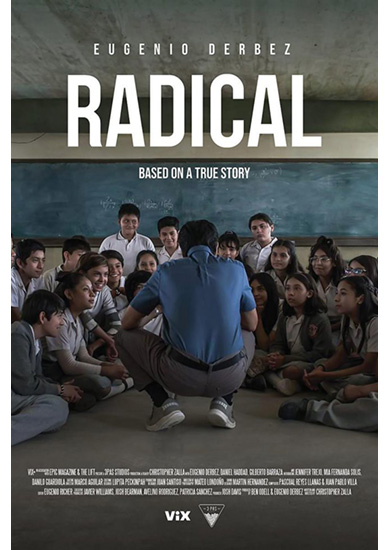
Film Notes
"“Radical,” a Spanish-language movie from Mexico, is based on the true story of an innovative and inspiring teacher in a poor community. Chucho (Daniel Haddad) runs an elementary school in a very poor community with corrupt officials and constant violence from gangs of drug dealers. Sergio (Eugenio Derbez) is the new teacher, brought on at the last minute when a faculty member quit just a day before school started. One of the other teachers scoffs that the only requirement for the faculty is a pulse.
Chucho has all but given up on giving the children a meaningful education because the students walk past yellow crime scene tape and murdered bodies on the way to school, the library’s encyclopedia is 30 years old, and the computer lab has been out of service for four years. Most students drop out after sixth grade to help their families or to join gangs. The bored students suffer through lectures, memorization, and busy work.
The school is often derisively referred to as “a place of punishment.” As the students line up in their uniforms for the first day of school, Chucho barks at them, “Silence is the foundation of obedience; obedience is the foundation of discipline, and discipline is the foundation of learning.” He has no interest in challenging established procedures or authorities. If the funding for the computer lab somehow disappeared and the teachers get early copies of the standardized tests so they can be sure to get bonuses when the students memorize the answers, all he can say to Sergio is, “No one gives a damn what happens here … don’t kick the hornets’ nest.”
Sergio Juárez Correa’s work at the José Urbina López Primary School in Matamoros, Mexico, was the subject of a 2013 Wired Magazine article titled, A Radical Way of Unleashing a Generation of Geniuses. One of the students was on the cover with the headline, “The Next Steve Jobs?” Correa was inspired by the ideas of Sugata Mitra, a British professor of educational technology, who proposed student-led learning, an updated, computer-enabled version of the ideas popularized in the 1960s by Summerhill founder A.S. Neill. “What do you want to learn?” Sergio (as he insists the students refer to him) asks. He encourages them not to worry about grades and not to be afraid of mistakes. “Who wants to be wrong first?”
When they first come to his classroom, the students pause at the door because he has turned the desks upside down and piled them in groups. He calls out to them that they are underwater, the desks are boats, and the students will drown if they cannot climb on board. But if there are too many people in a boat, it will sink. How can they determine the right number in each boat to save the most people? This makes the students want to learn about flotation, which means math and physics. It leads one student to ponder how we decide who to save when there is not enough room. Sergio tells her she is a philosopher, like John Stuart Mill. Another student, Paloma (Jennifer Trejo), becomes interested in math and astronomy. Sergio tells her she could be an aerospace engineer. Soon, Sergio has the students out on the playground, each a planet orbiting and spinning.
Derbez, always a charismatic screen presence, is at his best interacting with young people, as he did playing the music teacher in “Coda” and the quirky doctor in “Miracles from Heaven.” The young actors are exceptionally expressive, particularly Jennifer Trejo as Paloma, the WIRED cover model, a gifted young mathematician who lives with her father next to the garbage dump they glean to support themselves; Mia Fernanda Solis as Lupe, who goes to the college library to check out philosophy books but is forced to drop out of school to care for her baby brother; and Danilo Guardiola as Nico, whose brother has involved him in drug smuggling but who has begun to wish for a life of learning—and a closer relationship with Paloma.
Sergio wants to challenge the school’s systems, but most of all, he wants to challenge his sixth graders. He knows that what matters more than memorizing facts is to make them want to learn, to teach them how to learn, and to show them how capable and curious they can be. He does that for Chucho as well.
One of the movie’s most meaningful moments is when the two men sit down for a quiet talk. As Sergio and Chucho share the names of the teachers who inspired them, we see Chucho begin to reconnect with what led him to become an educator. If we are lucky, we have at least one teacher in our past who showed us what we are capable of. If not, Sergio can help remind us that it is never too late".
Nell Minow, Roger Ebert.com., November 1, 2023
‘Radical’ Review: Conventional Tearjerker About an Inspiring Teacher Benefits From a Terrific Ensemble.
"Fresh off 'CODA,' Eugenio Derbez plays another idealistic educator attempting to unlock overlooked students' potential, this time at a dysfunctional Mexican elementary school.
Idealistic teachers propel some of the most shamelessly schmaltzy tearjerkers of cinema, but whether we like it or not, we all respond to them at some sincere, emotional level. Christopher Zalla’s resolute crowdpleaser “Radical” is a heart-tugger in the mold of such old-school “inspiring teacher changes everything” tales as “To Sir With Love,” “Dead Poets Society” and even recent Oscar winner “CODA,” with which it shares star Eugenio Derbez. It’s a conventional film with broad audience appeal — watch it without tissues at your own risk — and hits all the expected notes.
That’s not necessarily a bad thing for a film centered on time-honored themes. Based on a true story, Zalla’s script is inspired by a decade-old WIRED article titled “A Radical Way of Unleashing a Generation of Geniuses” — the writer of which, Joshua Davis, serves as a producer here. In the piece, Davis zeroed in on a forgotten elementary school across the U.S. border in Matamoros, Mexico, detailing a persistent teacher’s innovative means of unlocking his students’ previously overlooked potential.
Aware of the story’s cinematic pull, Zalla — previously a Sundance 2007 winner for the grittily captivating “Sangre de Mi Sangre” — doesn’t try to reinvent the wheel, relying on a failsafe, often brazenly sentimental formula. Predictably, there are plenty of rousing moments, covering joy, heartbreak, failure and triumph, throughout this overlong film. But Zalla doesn’t shy away from a necessary dose of realism across the region’s majestic beaches and unattended dirt roads. “Radical” isn’t so much an irresponsibly magical against-the-odds yarn as a truthful one, in which a well-intentioned outsider can only go so far in protecting underprivileged students from certain grim paths.
Fresh off the aforementioned “CODA,” in which he played an endearing (if somewhat inauthentic) music teacher, the charming Derbez again portrays an educator with big ambitions, this time reaching for a wider range of emotions. We learn that his desperately clueless character, Sergio Juárez, had raised his own hand to teach at the José Urbina López Primary School, a derelict institution known as “a place of punishment” where others are sent if they fail elsewhere, or perhaps anger the wrong sort within the corrupt system. Having stumbled upon the method of British educational technology professor Sugata Mitra online, Sergio thinks that he can make a difference in the lives of these neglected students by teaching them how to think through complex ideas, all with the help of the computers that he believes the school has.
Run by the lovably grumpy principal Chucho (Daniel Haddad) — Sergio’s fiercest skeptic who gradually, of course, turns into his closest friend — the barely operational school has no such technology. What it has instead is heaps of promise through a vibrant array of pupils. Among them are scrappy Niko (Danilo Guardiola), thoughtful Lupe (Mía Fernanda Solis) and brainy, astronomy-obsessed Paloma (Jennifer Trejo) as the chief players. Many of the students in the film are said to be composites of real-life figures, with Paloma (deemed “the next Steve Jobs” on the cover that WIRED issue) perhaps one of the exceptions. Living by a dumpster with her sickly dad who scavenges scrap materials for a living, Paloma is quickly discovered by Sergio as a certified math genius and steadily grows into her potential as someone gifted enough to build her own telescope.
While Paloma clashes with her initially unsupportive father, Lupe and Niko have it even harder. With another baby on the way, the former’s family demands she stay at home to lend a hand, while the latter has long been mixed up with the locale’s merciless hoodlums. Still, Niko tries to sever ties with the thugs he works for in order to focus on his studies (and his adorable crush on Paloma), doing his best to avoid a fate lurking insidiously in the distance.
Along with DP Mateo Londoño and production designer Juan Santiso, Zalla presents Matamoros with unforgiving precision and occasionally, a touch of sweet hopefulness. “Radical” captures both the poverty and helplessness of a sweltering region that sees frequent killings and drug-related crime, and the modernity that exists on the other side of its tracks. Zalla also unearths pockets of bliss and humor in the kids’ everyday lives across numerous non-traditional classes with Sergio, who ruffles some feathers in the system as he puts his students’ wellbeing above all else".
By Tomris Laffly, Variety, Jan 19, 2023.
What you thought about Radical
Film Responses
| Excellent | Good | Average | Poor | Very Poor |
|---|---|---|---|---|
| 59 (81%) | 13 (18%) | 1 (1%) | 0 (0%) | 0 (0%) |
|
Total Number of Responses: 73 Film Score (0-5): 4.79 |
||||
Collated Response Comments
131 members and guests attended this screening. We received 73 responses giving a film score of 4.79 and a response rate of 56%.
Not too shabby. Many thanks. All of your responses are collected below.
“Never having been a teacher myself, but being married to one for a long time, my first thought was astonishment at the energy and initiative on display, and renewed respect for anyone (inc said wife) who can do that. The subject is something of a trope: disillusioned kids (and teachers), new broom, kids enthused, amazing results BUT, given extra heft with the knowledge that this actually happened. That said, excellent leads, great kids, and great portrayal of the reality of everyday poverty, crime and corruption in rural Mexico. Sound, photography and even subtitling all good”.
“Given that this is a true story, the question for the director must have been; how to pitch it? One imagines the reality of the story was somewhat tougher and grittier than the cinematic portrayal. As the story of the inspirational teacher is such a familiar one (after all we've already had one this season), how to avoid cliché and stereotypes ('Dangerous Minds' springs to mind as another true story that failed to entirely convince on both counts)? The film manages a fine balance; often comedic with the bleak background of the students’ lives not avoided but sketched in lightly. Sergio is as much a delight to us as to the students even if wandering uncomfortably close at times to one of Robin Williams' more sentimental performances. This is countered by the unvarnished realism of the children's playing which anchors the film with Paloma's quiet stoicism and Lupe's resignation. Please tell us Lupe made it back to school”.
“At first, I thought it rather lightweight and idealised the teacher, and how the children became self-motivated so quickly. But then the delightful relationship between the school director and the teacher began to give more depth. And soon growing hints of corruption in the authorities mirrored in the drugs trade was very powerful, and how ultimately destructive both are. A good choice”.
“A beautiful and sensitive film”.
“A major positive in Radical was to tell the story with sincerity and some humour, not a preoccupation with a poverty porn aspect. It could have fallen into a cliché of the capacity of individuals to triumph over socioeconomic barriers for dramatic purposes, yet the real life success story of Paloma and Sergio, shown in a 2013 Wired story denies such accusations. The metaphor of staying afloat and rocket ships defying gravity thread their way convincingly. Corruption though is just below the surface everywhere, yet hope of change also holds its ground, especially through Chucho, a cynic-turned-believer principal, maybe stereotyped yet a possible surrogate for our hopes.
Filming used classic lenses, understated colour that matches film's look to its themes. Matamoros, and Sergio's classroom, look dusty and poor, yet airy and filled with light. Classroom scenes felt spontaneous with Derbez, transformative teacher as he was in CODA. He remains convincing both in his positivity and then depressive post gang deaths stage. Inside this radical classroom, liveliness and humanity gain real ground. Equally, outside the violence, potential and real, is often hinted at indicating what this environment is like. Good that the plot focuses on three key children, without limiting their narratives into clumsy cliché. One big win (Paloma) a dreadful defeat (Nico) and Lupe unable to shake off the traditions of the eldest girl in a family. Thanks for showing this. Does the shift to hope serve a conservative outlook (recognising a status quo)? I'd like to think, though, aspects of reality can still be uplifting”.
“An absorbing film to highlight how education needs to keep evolving Worldwide. Acknowledging how the disadvantaged children in Mexico cope within the corrupt regime of the country and the education system. Are there many more countries in the world that fail the educational needs of their children today? Seeing this drama/biography gives me hope, that the education system, worldwide, can develop and adapt to the changing needs of our children today and our future generations to allow them to be inquisitive. To open the boundaries of education for all children today will enable them to change our world which is so important for our economy, our sustainability and to defy corruption. We forget within our very structured education system that all children are individuals and are not all able to conform to 'one size fits all'. An iconic Worldwide Public Relations film for Education!”
“What a great film! Radical had lots of humour with moments of great pathos. Sergio exemplified the kind of teacher we all wish we had had at school or reminded us of one we did have. His passion for leading the children to knowledge was awe inspiring and I marvelled at how he manages to retain that passion given the bleak circumstances of the school. Keep it up GFS”.
“Feel good film for a winter's evening! Very engaging characters and well acted by leads and children. Could have been in danger of becoming cliche'd with characters like the lazy teacher who preferred to cheat rather than put effort in, but the context of the violence and hardships of a Mexican border town balanced that out to produce an excellent result. For a longish film it flew past, always a good sign! Another good choice. Thanks”.
“The theme of the film felt a little similar to that of the Mongolian film, 'Lunana, Yak in the Classroom', in the sense that the teachers are able to draw out children's talents--and that in itself was simply lovely to see. The cinematography was great, as was the sense of continuity in the editing. The beautiful friendship between the two teachers also felt right and moving. Thank you!”
“Inspirational and powerful. Subtle/not overacted. Young actors particularly impressed. Most enjoyable but really thought provoking”.
“So inspirational! I loved it”.
“Excellent film. Before I came, I was wondering if subtitles for Spanish speaking movie would be difficult to read but it was not a problem at this showing and did not spoil my enjoyment of the film. My daughter is a new teacher and so I am going to recommend this film to her. It portrayed well the abject poverty of this part of the world in Mexico and the harsh realities these children face and the effect of corruption”.
“Thoroughly enjoyable film”.
“Based on real events and assuming that the closing stats were true, then this was the second time in this season we were given very instructive lessons on how to teach against all the odds. Very impressive. Just sad to guess that most teaching will continue to be teaching to the test”.
“If this wasn’t based on a true story, you would wonder about its truth. What a tragic, heartrending story. I loved every minute”.
“Wonderful acting”. “I didn’t look at my watch at all”.
“Amazing that it is also true. Great acting”.
“Muy Buen – very good”. “Thank you – inspirational”.
“A fact-based story. Well told”.
“Memorable, beautiful, fabulous”.
“Brilliant. So well filmed and acted”. “Outstanding”.
“Oh Wonderful. What a fantastic film. Words fail me. What a teacher”.
“Heart rending. Well-acted, particularly Sergio. Not over played. Well directed and scripted – not the overbearing stereotypes one might expect”.
“This film was fantastic. Beautifully shot, emotional and yet funny”.
“Absolutely Brilliant. Best film I have seen in years. Inspirational”.
“A sad but joyous film Well scripted is and beautifully filmed. Quite inspirational”.
“What a wonderful film”. “Very moving – Great performances and never dragged”.
“And so, the fight goes on!” “Inspiring” “Wow”
“Brilliant. So enjoyable and inspiring”.
“That was so good. Thank you. Very moving”.
“It needs to be on general release, so people can learn from it. Hopefully to make the world a better place”.
“A great film. Sergio was obviously an amazing teacher who fought against the odds to ensure that his pupils could succeed. An inspiring film, sad that he had to fight so hard”.
“Goes to show how lucky our children are. Those children were very brave”.
“Amazing and thought provoking”.
“Love feel good movies like this. Everyone should watch it – especially those in charge of the education system”.
“A beautiful film which I will remember and think about for a long time. Well directed – music used well to compliment the film”.
“An inspiring and wonderful story”.
“A truly inspiring film”. “Heart-warming”.
“Rather long and complicated but great actors and actresses”.
“Inspirational”.
What is F-Rated?
The F-Rating is applied to all films which are:
- Directed by women
- Written by women
- Has one or more significant women on screen

If it qualifies with one of the above it gets the Bronze rating.

If it qualifies with two of the above it gets the Silver rating.

If it qualifies with all three of the above it gets the Gold rating.
What is F-Rated?
The F-Rating is applied to all films which are:
- Directed by women
- Written by women
- Has one or more significant women on screen
If it qualifies with one of the above it gets the Bronze rating.
If it qualifies with two of the above it gets the Silver rating.
If it qualifies with all three of the above it gets the Gold rating.