The Earrings of Madame De
When an aristrocratic woman known only as "Madame de ..." selles a pair of earrings given to her by her husband in order to pay some debts, she sets off a chain reaction of financial and carnal consequences that can only end in despair.
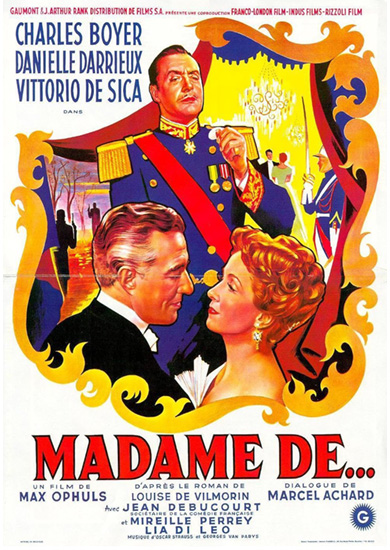
Film Notes
"Unhappiness is an invented thing.
So the General tells his wife. He is convinced she wants to be unhappy. She places herself willfully in the way of sadness. It is her choice. There was a time when Louisa would have agreed with him, when their views on society matched perfectly. But now she is truly unhappy, and it is beyond her choice. The General will never understand that. Neither, probably, will her lover, the Baron. It is the gift these men have given her: The ability to mourn what she has lost or never found. It is the one gift they cannot take back. Without it, she would have been unable to understand happiness. Certainly the men cannot.
“The Earrings of Madame de…,” directed in 1953 by Max Ophuls, is one of the most mannered and contrived love movies ever filmed. It glitters and dazzles, and beneath the artifice it creates a heart, and breaks it. The film is famous for its elaborate camera movements, its graceful style, its sets, its costumes and of course its jewelry. It stars Danielle Darrieux, Charles Boyer and Vittorio De Sica, who effortlessly embody elegance. It could have been a mannered trifle. We sit in admiration of Ophuls’ visual display, so fluid and intricate. Then to our surprise we find ourselves caring.
The story takes place in Vienna a century or so ago. The General (Boyer) has married late, and well, to Louisa (Darrieux), a great beauty. He gives her expensive diamond earrings as a wedding present. As the film opens, Madame is desperately in debt, and rummaging among her possessions for something to sell. The camera follows her in an unbroken shot as she looks through dresses, furs, jewelry, and finally settles on the earrings, which she never liked anyway. “What will you tell your husband?” asks her servant. She will tell him that she lost them.
She trusts the discretion of Remy the jeweler. She should not. Remy, who originally sold the earrings to the General, tells him the whole story. The General buys back the earrings as a farewell present to his mistress, who is leaving him and going to Constantinople. Certainly the wife will never see them again, and there is poetic justice involved.
The mistress sells the earrings to finance her gambling. The Baron Donati (De Sica) buys them. In his travels he encounters the Countess Louisa, falls in love, courts her, and gives her the earrings. She is startled to see them, but intuits how they came into the Baron’s hands. How to explain their reappearance to the General? In his presence, she goes through the motions of “finding” them. The General knows this is a falsehood, and the whole tissue of deceptions unravels, even though the jewels are bought and sold two more times. (There is always a laugh when the jeweler turns up in the General’s office for “our usual transaction”).
Standing back a little from the comings and goings of the earrings, which is the stuff of farce, the movie begins to look more closely at Louisa (whose husband’s name is never given, so that she is always vaguely the “Countess de…”). She and her husband live in a society where love affairs are more or less expected; “your suitors get on my nerves,” the General fusses as they leave a party. If they do not know specifically who their spouse is flirting with, they know generally. But there is a code in such affairs, and the code permits sex, but not love. The General confronts the Baron with his knowledge of the earrings. (“Constantinople?” “Yes.”) The General tells him, “It is incompatible with your dignity, and mine, for my wife to accept a gift of such value from you.”
The General’s instinct is sound. The Countess has indeed fallen in love. The Baron thought that he had, too. Their tragedy is that the intensity of her love carries her outside the rules, while the Baron remains safely in-bounds.
The scene where they fall in love shows Ophuls’ mastery. He likes to show his characters surrounded by, even drowning in, their milieu. Interior spaces are crowded with possessions. Their bodies are adorned with gowns, uniforms, jewelry, decorations. Ophuls likes to shoot past foreground objects, or through windows, to show the characters contained by possessions. But in the key love scene, a montage involving several nights of dancing, the circling couple is gradually left all alone.
The Baron and the Countess are at a resort. On the dance floor, they observe it has been three weeks since they danced together–two days–one day–and then they are dancing still and no time has passed. The dialogue and costumes indicate the time transitions, but the music plays without interruption, as do their unbroken movements. They dance and dance, in love. An admiral’s wife whispers: “They’re seen everywhere–because they can’t meet anywhere.” On the last night, one orchestra member after another packs up and goes home. A servant extinguishes the candles. Finally a black dropcloth is thrown over the harp, and the camera moves in until the screen is black and the dance is over. The economy of storytelling here–a courtship all told in a dance–resembles the famous montage in “Citizen Kane” where a marriage dissolves in a series of breakfasts.
The discovery of a possession in the wrong place at the wrong time is an ancient trick in fiction, from Desdemona’s handkerchief to Henry James’ Golden Bowl to the brooch that should not be around Judy’s neck in “Vertigo.” What is interesting in “Madame de…” is the way the value of the earrings changes in relationship to their meaning. At the start Madame Louisa wants only to sell them. Then, when they are a gift from her lover, they become invaluable. The General wants to buy them back once, twice, but finally is reduced to telling the jeweler, “Stay away from me with those infernal earrings!” An expensive bauble, intended to symbolize love, becomes an annoyance and a danger when it finallydoesrepresent it.
For Louisa, the earrings teach a lesson. She is no more morally to blame than her husband or her lover, if only adultery is at stake. But if the General’s honor is the question–if being gossiped about by the silly admiral’s wife is the result–then she is to blame. Certainly the Baron understands this, and withdraws, his love suddenly upstaged by his regard for his own reputation. The final meeting between the two men is brought about, curiously, by the General’s discovery that hedoeshave real feelings for his wife.
Max Ophuls (1902-1957) was a German who made films in Germany, Hollywood and France. His career was used by the critic Andrew Sarris as a foundation-stone of his auteur theory. Sarris famously advised moviegoers to value thehowof a movie more than thewhat. The story and message are not as important, he said, as the style and art. In Ophuls, he had a good test case, because Ophuls is seemingly the director most obsessed with surfaces, with the visual look, with elaborate camera movements. He was dismissed by many as nothing more than a fancy stylist, and it took Sarris (and the French auteurists) to show what a master he was.
His films are one of the great pleasures of the cinema. “Madame de…” is equaled by “La Ronde” (1950) and “Lola Montes” (1955) as movies whose surfaces are a voluptuous pleasure to watch, regardless of whether you choose to plunge into their depths. The long, impossibly complex opening shot of “La Ronde,” with the narrator introducing us to the story and even singing a little song, is one of the treasures of the movies. And who else has such romantic boldness that he will show Louisa writing her Baron day after day, with no letter back, and then have him tell her when they finally meet: “I always answered your letters, my love–but I lacked the courage to mail them.” And then to show his unmailed letters torn into bits and flung into the air to become snow"
Roger Ebert, Chicago Sun Times, November 11, 2001
The Earrings of Madame de… (1953)
Pauline Kael’s review of The Earrings of Madame de… praises Max Ophuls’s lush, romantic cinematic style, contrasting it with the austere, almost mathematical prose of Louise de Vilmorin’s novella. Ophuls’s fluid camera work and seamless transitions, such as the continuous movement from ball to ball, create a hypnotic and seductive rhythm that envelops the viewer. The performances by Danielle Darrieux, Charles Boyer, and Vittorio De Sica are noted for their impeccable ensemble playing. Kael addresses the criticism Ophuls faced for his focus on elegance and style, arguing that his evocation of a vanished, refined past was essential for exploring the nuances of love. Ophuls’s background, marked by displacement and a struggle to realize his artistic vision during and after World War II, adds depth to his nostalgic and intricate cinematic expression.
"Madame de, a shallow, narcissistic beauty, has no more feeling for her husband than for his gifts: she sells the diamond earrings he gave her rather than confess her extravagance and debts. Later, when she falls in love with Baron Donati, he presents her with the same pair of earrings and they become a token of life itself. Once she has experienced love she cannot live without it: she sacrifices her pride and honor to wear the jewels, she fondles them as if they were parts of her lover’s body. Deprived of the earrings and of the lover, she sickens . . . unto death.
This tragedy of love, which begins in careless flirtation and passes from romance, to passion, to desperation is, ironically, set among an aristocracy that seems too superficial and sophisticated to take love tragically. Yet the passion that develops in this silly, vain, idle society woman not only consumes her but is strong enough to destroy three lives.
The novella and the movie could scarcely be more unlike: the austere, almost mathematical style of Louise de Vilmorin becomes the framework, the logic underneath Ophuls’s lush, romantic treatment. In La Ronde he had used Schnitzler’s plot structure but changed the substance from a cynical view of sex as the plane where all social classes are joined and leveled (venereal disease is transmitted from one couple to another in this wry roundelay) — to a more general treatment of the failures of love. For Ophuls La Ronde became the world itself — a spinning carousel of romance, beauty, desire, passion, experience, regret. Although he uses the passage of the earrings as a plot motif in the same way that Louise de Vilmorin had, he deepens and enlarges the whole conception by the creation of a world in such flux that the earrings themselves become the only stable, recurrent element and they, as they move through many hands, mean something different in each pair of hands, and something fatally different for Madame de because of the different hands they have passed through. It may not be accidental that the film suggests de Maupassant: between La Ronde and The Earrings of Madame de . . . Ophuls had worked (rather unsuccessfully) on three de Maupassant stories which emerged as Le Plaisir.
In these earlier films he had also worked with Danielle Darrieux; perhaps he was helping to develop the exquisite sensibility she brings to Madame de — the finest performance of her career. Her deepening powers as an actress (a development rare among screen actresses, and particularly rare among those who began, as she did, as a little sex kitten) make her seem even more beautiful now than in the memorable Mayerling — almost twenty years earlier — when, too, she had played with Charles Boyer. The performances by Danielle Darrieux, Charles Boyer, and Vittorio De Sica are impeccable — ensemble playing of the smoothness usually said to be achieved only by years of repertory work.
However, seeing the film, audiences are hardly aware of the performances. A novelist may catch us up in his flow of words; Ophuls catches us up in the restless flow of his images — and because he does not use the abrupt cuts of “montage” so much as the moving camera, the gliding rhythm of his films is romantic, seductive, and, at times, almost hypnotic. James Mason once teased Ophuls with the jingle: “A shot that does not call for tracks is agony for poor dear Max.” The virtuosity of his camera technique enables him to present complex, many-layered material so fast that we may be charmed and dazzled by his audacity and hardly aware of how much he is telling us. It is no empty exercise in decor when Madame de and the Baron dance in what appears to be a continuous movement from ball to ball. How much we learn about their luxurious lives, the social forms of their society, and the change in their attitudes toward each other! By the end, they have been caught in the dance; the trappings of romance have become the trap of love.
The director moves so fast that the suggestions, the feelings, must be caught on the wing; Ophuls will not linger, nor will he tell us anything. We may see Madame de as a sort of Anna Karenina in reverse; Anna gets her lover but she finds her life shallow and empty; Madame de’s life has been so shallow and empty she cannot get her lover. She is destroyed, finally, by the fact that women do not have the same sense of honor that men do, nor the same sense of pride. When, out of love for the Baron, she thoughtlessly lies, how could she know that he would take her lies as proof that she did not really love him? What he thinks dishonorable is merely unimportant to her. She places love before honor (what woman does not?) and neither her husband nor her lover can forgive her. She cannot undo the simple mistakes that have ruined her; life rushes by and the camera moves inexorably.
The very beauty of The Earrings of Madame de . . . is often used against it: the sensuous camerawork, the extraordinary romantic atmosphere, the gowns, the balls, the staircases, the chandeliers, the polished, epigrammatic dialogue, the preoccupation with honor are all regarded as evidence of lack of substance. Ophuls’s reputation has suffered from the critics’ disinclination to accept an artist for what he can do — for what he loves — and their effort to castigate him for not being a different type of artist. Style — great personal style — is so rare in moviemaking that critics might be expected to clap their hands when they see it; but, in the modern world, style has become a target, and because Ophuls’s style is linked to lovely ladies in glittering costumes in period decor, socially-minded critics have charged him with being trivial and decadent. Lindsay Anderson, not too surprisingly, found him “uncommitted, unconcerned with profundities” (Anderson’s Every Day Except Christmas is committed all right, but is it really so profund?) and, in his rather condescending review of The Earrings of Madame de . . . in Sight and Sound, he suggested that “a less sophisticated climate might perhaps help; what a pity he is not, after all, coming to make a film in England.” It’s a bit like telling Boucher or Watteau or Fragonard that he should abandon his pink chalk and paint real people in real working-class situations.
The evocation of a vanished elegance — the nostalgic fin de siècle grace of Ophuls’s work — was perhaps a necessary setting for the nuances of love that were his theme. If his characters lived crudely, if their levels of awareness were not so high, their emotions not so refined, they would not be so vulnerable, nor so able to perceive and express their feelings. By removing love from the real world of ugliness and incoherence and vulgarity, Ophuls was able to distill the essences of love. Perhaps he cast this loving look backward to an idealized time when men could concentrate on the refinements of human experience because in his own period such delicate perceptions were as remote as the Greek pursuit of perfection.
Born Max Oppenheimer in Germany in 1902 (he changed his name because of family opposition to his stage career) he worked as an actor and then directed more than 200 plays before he turned to movies in 1930. His first film success, Liebelei, came in 1932; because he was Jewish, his name was removed from the credits. The years that might have been his artistic maturity were, instead, a series of projects that didn’t materialize or, if started, couldn’t be completed. He managed to make a few movies — in Italy, in France, in Holland; he became a French citizen; then, after the fall of France, he went to Switzerland, and from there to the United States, where, after humiliating experiences on such films as Vendetta he made Letter from an Unknown Woman, Caught, and The Reckless Moment. In 1950 in France he finally got back to his own type of material with La Ronde; the flight from Hitler and the chaos of the war had lost him eighteen years. Working feverishly, with a bad heart, he had only a few years left — he died in 1957. No wonder the master of ceremonies of La Ronde says, “J’adore le Passé”; the past of Ophuls’s films is the period just before he was born. There was little in his own lifetime for which he could have been expected to feel nostalgia. Perhaps the darting, swirling, tracking camerawork for which he is famous is an expression of the evanescence of all beauty — it must be swooped down on, followed. It will quickly disappear".
Pauline Kael, Kulchur, 1961.
What you thought about The Earrings of Madame De
Film Responses
| Excellent | Good | Average | Poor | Very Poor |
|---|---|---|---|---|
| 10 (21%) | 26 (54%) | 11 (23%) | 0 (0%) | 1 (2%) |
|
Total Number of Responses: 48 Film Score (0-5): 3.92 |
||||
Collated Response Comments
96 members and guests attended this screening. We received 48 responses giving a film score of 3.92 and a response rate of 50%.
Thanks so much for all of your comments. They are all collected below.
“Obsessive love never ends well but I enjoyed the ride, especially the endless dance and the general's advocacy of companionship”.
“An amusing story set among beautiful people and sumptuous settings. If only it could have been in colour”.
“Fin de-siecle material quite strikingly filmed. Some well structured tracking shots choreographed rather than merely directed. A dance between Louise and Donati is cut with time lapse to tell the story of their brief romance with great effect. Liked the conceit of what obscuring Louisa's last name adds as Ophuls took this from the book which inspired it, apparently "Madame de [Blank]" it's a gossip-column touch of realism. The earrings are a punctuation to acts in the narrative adding to the story's thread as is Louise's anonymity. It's not all doom and gloom though. Tragedy of errors brings comic touches in some incidental characters – the jeweller's son, the valets at the opera. But there's 19th century grace with several ballroom scenes. Liked the visual metaphor of carriage wheels entwining. Difficult not to reduce this 1953 film to a trope of toxic masculinity – wonder what Ophuls would have made of it, given his critical portrayal of women as objects of desire. We understand the selfishness of elites, as well as the personal emptiness of the people desperate to find their purpose in vanity. A true melodrama”.
“The politics of this movie are hard to tease out, especially at this remove from its filming. On the face of it: fragile and emotional woman is lost to the inflexible and hypocritical morality of upper class masculine societal codes. Or: weak, blinkered, privileged woman is lost to the codes of her class. Or upper classes self-immolate under their own rules (as a metaphor for the approaching war?). The Belle Epoque lives up to its name in a dizzying cinematic display of mirrored and reflective surfaces, silks, satins and impressive epaulettes but it is a society that, as Ophuls surely knows, is about be obliterated in the abattoir of Flanders and Verdun (nodded to with the 'It's the new 90mm' sounding the death knell outside the barracks). So what is the director's intention? The lazy assumptions of the over-privileged leads certainly raise my inner sans culottes but I assume his main intent is to match societal codes against the heart and generate some sympathy for the unthinkingly entitled Louise in her descent. Excellent and thought provoking, a very interesting change of tack for the season”.
“Different but glad to have watched it. Jumped around quickly between scenes but surprisingly fresh for a 1950s film presumably set around the turn of the century. Moments of humour but all rather sad in the end. An interesting choice. Thanks”.
“Visually luxurious with a promising start but I found the plot tiresome. I didn't feel any empathy towards the main characters and found the ending a relief!!”
“I really enjoyed the nostalgia the actors and actresses emitted from this beautiful story. The joy from watching this film made the winter rain seem insignificant. Have we seen Le Plaisir?”
“Great, really enjoyable. Sad ending/unexpected”.
“I liked that it was about older love”.
“Gallic charm”. “Very enjoyable!” “Confusing”.
“Very different and of course old fashioned”.
“Extended a little longer than needed”.
“Interesting. Good performances”.
“Was this supposed to be a morality tale? Really wish it had been in colour to appreciate the sumptuousness of the clothing and scenery etc.”.
“Enjoyed the film – except for the ending. Something and nothing!”
“A nice gentle story”.
“I was a bit confused. The plot seemed to jump about. I need to watch it again!”
“Unusual but enjoyable”.
“Very good but the ending was a bit unsatisfactory”.
“Liked the frocks! Atmospheric use of candles”.
“Great photography. Some interesting twists but too long”.
“A bit long winded”.
“Funny sometimes but not sure what the intention was”.
“Very dramatic and well filmed. A complex story. Loved the costumes”.
“Confusing end and throughout. But fun nevertheless, especially how the earrings kept turning up”.
What is F-Rated?
The F-Rating is applied to all films which are:
- Directed by women
- Written by women
- Has one or more significant women on screen

If it qualifies with one of the above it gets the Bronze rating.

If it qualifies with two of the above it gets the Silver rating.

If it qualifies with all three of the above it gets the Gold rating.
What is F-Rated?
The F-Rating is applied to all films which are:
- Directed by women
- Written by women
- Has one or more significant women on screen
If it qualifies with one of the above it gets the Bronze rating.
If it qualifies with two of the above it gets the Silver rating.
If it qualifies with all three of the above it gets the Gold rating.