Hen
Told entirey from the perspective of its protagonist, the film follows the adventures of a hen, desperate to raise a family who escapes an industrial farm only to find herself navigating the pecking order of a decaying seaside restaurant in Greece.
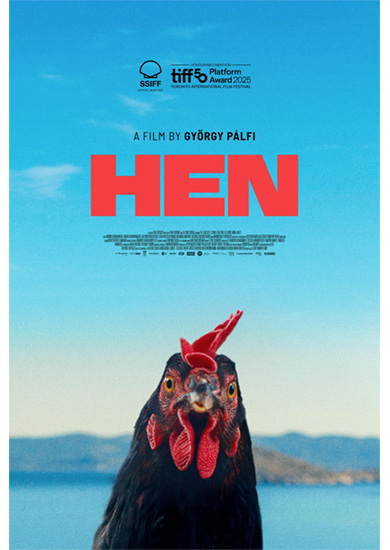
Film Notes
Hen review: Five stars for this compelling chicken-themed thriller
Plucky heroine of György Pálfi’s compelling tale an unlikely emblem of ordinary existence under late-capitalist criminality
Be warned. Hen opens with pornographic detail: an anatomical close-up of a chicken laying an egg. It’s simultaneously comic, verging on body horror, and wholly arresting.
György Pálfi, the director of the cult 2006 horror hit Taxidermia, is not interested in the tasteful, wide-eyed anthropomorphism of common-or-garden nature films or Disney critters. His chicken-themed thriller is a surprising, quietly disconcerting fable told almost entirely from the perspective of a single hen.
The chick that hatches during the opening shot is distinguished from the flock by her dark plumage: she’s an easily spotted protagonist in a sea of white feathers.
Rejected by the machinations of industrial farming, she escapes slaughter and drifts through a hostile rural landscape with the hobo beats of such TV classics as The Fugitive or The Incredible Hulk. All the while she is driven by little more than pecking instinct and flight-or-(barely)-flight instinct.
Pálfi keeps the camera low to the ground, tethered to the hen’s eye line as she navigates foxes, pigeons, indifferent humans and the endless dangers of staying alive.
In common with Viktor Kossakovsky’s pig-themed Gunda and Jerzy Skolimowski’s EO, human matters happen in the margins, yet they are consistently menacing. Snatches of conversation, bursts of violence and hints of corruption sketch a gangland plot and a supposedly superior species hollowed out by fear, moral exhaustion and gangsterism.
The oblivious titular heroine is comparatively swashbuckling beside these compromised, weary signifiers trapped within corrupt systems they neither control nor resist. She becomes an unlikely emblem of ordinary, shifting existence under late-capitalist criminality.
Pálfi never labours the allegory too hard. Instead, the increasingly fretful story accumulates through the ordinary trials and tribulations of chicken life. Mundane routines acquire a creeping dread, with barns, kitchens and farmyards becoming landscapes of unspoken terror as the heroine clucks her way through a compelling story.
Tara Brady, The Irish Times, May 20 2026
Hen review – plucky chicken beats the odds in weirdly uplifting survival story
In a feat of cinematic mystery and skill György Pálfi coaxes a tour de force from his poultry cast in this parable of animal and human interrelations
Hungarian film director György Pálfi has long been a one-off talent: a surrealist-formalist of sorts who is equally comfortable making a romantic film comprised of hundreds of clips from other movies (Final Cut: Ladies and Gentlemen), a sick-puppy black comedy about a taxidermist living in a house full of cats (Taxidermia), and a near-silent, portrait of sinister village life in which one character has permanent hiccups (Hukkle). By comparison, his latest, Hen is practically mainstream. That is really saying something given it’s a film whose main character is a black-brown hen (played by about eight poultry thespians and not CGI) who quizzically observes a world where humans treat each other like, well, animals. Comparisons have inevitably been made to a couple of recent features with animal protagonists, such as Andrea Arnold’s Cow and Jerzy Skolimowski’s donkey-centric EO, but Hen is lighter and more amusing, if one can say that of a film that features an extended subplot about human trafficking with deadly consequences.
How Pálfi manages to pull this off is a cinematic mystery, but it probably has to do with his light tonal touch and his ability to truly empathise with his avian heroine without resorting to anthropomorphic sentimentalism. This hen acts much like a real chicken in that she combines shrewd survival instincts and utter gormlessness to a winning degree. For example, after surviving the Greek battery farm where she hatches (a wee black speck in a sea of yellow chicks), she manages to escape the clutches of a trucker who plans to make dinner out of her. Just when you think she has found safety, a fox (amazingly well trained, and also not CGI as far as I can tell) starts stalking her, chasing her into a busy road where the chicken literally crosses the road with the blithe idiocy that makes chickens so adorable. The fox isn’t so lucky. Incidentally, the film does have a disclaimer at the end averring that no animals were harmed during the making of the movie, which is a relief.
In fact, the cinematic universe where this story unfolds is just as ruthless to homo sapiens. The hen ends up living at a rundown disused restaurant with a view of the seaside, owned by an elderly man (Yannis Kokiasmenos) who takes a bit of a shine to her after she keeps managing to escape the mangy coop where he puts her. It’s no surprise she longs to get out: she is bullied by the other hens while the cockerel, a wretched-looking creature who, like the rest of the flock, has lost most of his neck feathers due to chicken-on-chicken violence, copulates violently with her every day. Behaviour-wise the humans are no better, especially the old man’s daughter’s boyfriend, who is in cahoots with gangsters trafficking refugees that they hide at the restaurant, packed in dark rooms with water if they’re lucky – just like the chickens we saw at the beginning. And while it all doesn’t end well for any of the people, there’s some tiny solace in seeing that at least life goes on for other creatures. The film is an amazing feat of animal training and deft editing, and it’s all so weirdly cheering.
Leslie Felperin, The Guardian, 21st May 2026.
What is F-Rated?
The F-Rating is applied to all films which are:
- Directed by women
- Written by women
- Has one or more significant women on screen

If it qualifies with one of the above it gets the Bronze rating.

If it qualifies with two of the above it gets the Silver rating.

If it qualifies with all three of the above it gets the Gold rating.
What is F-Rated?
The F-Rating is applied to all films which are:
- Directed by women
- Written by women
- Has one or more significant women on screen
If it qualifies with one of the above it gets the Bronze rating.
If it qualifies with two of the above it gets the Silver rating.
If it qualifies with all three of the above it gets the Gold rating.