Film Notes
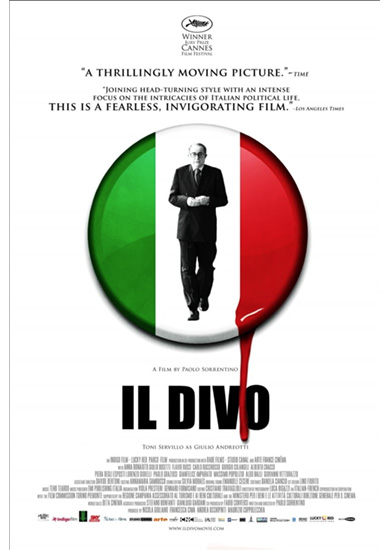
Some months ago, Matteo Garrone's brutal thriller Gomorra effectively denounced all of Italy for being in hock to the gangsters. The country was breeding a cynical and complacent political class who were complicit in every sort of criminal activity, the most egregious of which was the unlawful dumping of nuclear waste - literally undermining Italy with poison. Now Paolo Sorrentino, perhaps the most brilliant director of the new Italian wave, gives us a bird's-eye view of the same grisly situation, a film about the inscrutable mandarin and postwar political survivor Giulio Andreotti: three times prime minister and Realpolitik specialist, leader of the notionally centrist Christian Democrat party and the silent spider at the centre of a vast conspiratorial web of shady deals.
He is played, mesmerically, by Toni Servillo as an undead bureaucrat, a drab Dracula in a shabby suit and boring spectacles. The movie covers his life from the early 1980s, just after the murder of Aldo Moro, to the 90s, when he is arraigned and then unconvincingly acquitted of mafia involvement. The movie finishes just before Andreotti cedes pre-eminence to Silvio Berlusconi, rather like Tiberius giving way to Caligula.
Il Divo (or The God) is composed in Sorrentino's unique and unmistakable style, with masque-like ensemble scenes, rectilinear camera positions, Steadicam-swoops along vertiginous perspectives and sudden pulses of jagged, angular electropop on the soundtrack. For each of Sorrentino's two previous movies, The Consequences of Love (2004) and The Family Friend (2006) I have used the word "Jonsonian" and here, the comparison is more irresistible than ever: one of Andreotti's nicknames is the Fox. The satire is dry, harsh, almost scorched in its texture: there is no gentleness, no emollient inner life to Sorrentino's bewilderingly huge cast of characters; they have no humanising touches and appear motivated by fear and gain in that order - although Andreotti has moments of droll intimacy with his wife.
Servillo's bizarre figure embodies the film: he is a corpse tilted upright, with a pallor and clothes suitable for someone in an open casket. His Andreotti moves along the corridors of power in a constricted pigeon-toed gait, with geisha-steps so tiny it looks as if he's moving on casters. He has hunched shoulders and chin pushed back creating a bloated, toadish neck, elbows cinched to the sides, hands primly clasped together. He looks like no human being I have ever seen in my life: the figure of a man shaped by shabby compromise, chronic migraines and a grim determination to conquer through survival.
Andreotti's associates, including a thin-lipped Cardinal, arrive for conferences like Scorsese's wise-guys or Tarantino's colour-coded bank-robbers. They move with the malign heaviness of natural predators: Sorrentino's camera lingers over details such as the suspension of a luxury car heaving as a politician is disgorged. Their conversation is snappy, oblique, opaque - riddled with mutual distrust. Andreotti largely maintains a reptilian silence. When he and his allies let their hair down, the spectacle is even more bizarre; there are nightmarish parties and receptions in which middle-aged men and women disport themselves to ethnic drumming and a cocktail called the "Transgression" is served.
Scenes such as these have a stylised, theatrical quality, contrasting with a kinetic fluidity in the montages of violence, showing various wet-jobs carried out against high-profile bankers, politicians, mobsters and masons, murders identified with Saul Bass-type titles embedded three-dimensionally into the scene. This is the reality of blood and fear that exists beneath the choreography of power. It is as if Andreotti glimpses it but, like a tightrope-walker, does not wish to look down. He says he feels guilty about the Red Brigade's 1978 murder of Aldo Moro, avowedly because he refused to negotiate with the terrorist-kidnappers. But it is not as simple as that. What Andreotti himself calls the strategia della tensione, or "tension strategy" dictated a secret policy of provoking and faking terrorist chaos in order to justify authoritarian clampdowns, to endow the supposedly moderate Christian Democrats with legitimacy, and to make traditional mafia crime, so lucrative for all concerned, look comparatively wholesome. I was reminded of Michele Placido's Romanzo Criminale (2005), which advances some similar ideas about a murky truth behind the Bologna station bomb of 1980.
Andreotti has only one emotional moment, when in a clenched aria of self-justification he declaims the necessity of "perpetrating evil to guarantee good" - wicked acts will save the state, in other words - and how good needs this kind of evil. He, Andreotti, understands this and so does God Himself. A whiff of sulphur comes off the screen at this moment: Il Divo is one of those very few films in our secular age with a genuine sense of sin. Sorrentino's antihero reminded me of the unhappy Marshal Pétain in Vichy France, who thought of himself as a "sacrifice", a man who believed his destiny was to absorb the deepest shame and personal dishonour in the interest of his country's survival.
This is a deeply strange and utterly hypnotic film, almost traumatised with its own information overload and by the frenetic accumulation of data pointing to one conclusion: that Italy's politicians have tainted the country with corruption and secret shame. Toni Servillo's Andreotti is a macabre masterpiece.
Peter Bradshaw, The Guardian, 20 Mar 2009.
They would seem to be opposites, but on the basis of two recent films, the longtime Italian Prime Minister Giulio Andreotti and the longtime fashion emperor Valentino were surprisingly similar. Both are seen as intensely private, rarely happy, single-minded in pursuit of their ambitions, cool in their personal relationships, and ruling as if by divine right. A difference is that Valentino was never accused of criminal activities.
Another difference is that they’ve inspired radically different films. “Valentino: The Last Emperor” is reverential; “Il Divo” is fascinated by what it presents as Andreotti’s lifelong career of skullduggery. Still serving the Italian state as a senator for life at the age of 90, he entered politics in 1946 and was prime minister during most of the years between 1972 and 1992. During much of that time, he was widely believed to have associations with the Mafia, and “Il Divo” shows him imagining a confession to his wife in which he links himself to 236 deaths. One of those might include the murder of Aldo Moro, his political rival, who was kidnapped by the Red Brigades and killed after 54 days when Andreotti shockingly refused to negotiate a ransom.
What you would not guess from this history is that “Il Divo” is a deadpan, horrified comedy. The writer-director Paolo Sorrentino is fascinated by Andreotti’s wicked intelligence, his awareness that so many believe the worst of him, his enigmatic mask. He fascinated his contemporaries; Margaret Thatcher once said of him, “He seemed to have a positive aversion to principle, even a conviction that a man of principle was doomed to be a figure of fun.” He said of himself: “Power is a disease one has no desire to be cured of.” He knew where all the strings were attached and once told a pope: “Your Holiness, forgive me, but you don’t know the Vatican like I do.”
What is astonishing is that a film like this could be made about a man still living. One imagines Andreotti reflecting that it only enhances his larger-than-life image. His Christian Democrats ruled postwar Italy until 1992, by which time the party was in such disrepute that it no longer survives. Yet he prevails. He prevails, and the legend is only enhanced by the great performance here by Toni Servillo, an actor who succeeds in making him hypnotizing by supplying him with an almost cheerful lack of the slightest magnetism. Here was a man who suppressed the usual charm of a politician, perhaps aware he worked better as an enigma. Was he thinking of himself when he famously said, “You sin in thinking bad about people; but, often, you guess right.”
The film proceeds like a black comedy version of “The Godfather,” crossed with Oliver Stone’s “Nixon.” It assembles a roll call of figures in postwar Italian politics, society and crime, uses an abundance of names and dates in captions, and makes us despair of keeping track until we realize we’re not intended to — the purpose of all these facts is simply to evoke the sheer scope and breadth of Andreotti’s machinations. The more we learn, the more fascinated we become, as Servillo portrays him as poker-faced, hunched, impassive, observing all, revealing little, wise and cynical beyond measure. Imagine Dick Cheney without the jolly charisma.
After I saw “Il Divo,” I suppose I should have felt indignation. I suppose I should also have felt that way after “The Godfather.” But such films present such mesmerizing figures that I simply regard them, astonished. I wonder if just before a snake strikes you, you think: What an amazing snake! The Italians, you have to admit, get good value for their money. Who could possibly follow Andreotti as prime minister? Try Silvio Berlusconi.
Note: “Il Divo” was also the nickname of Julius Caesar, a nickname suggesting “the divine one.” Andreotti’s other nicknames: Beelzebub, the Hunchback, the Sphinx and the Black Pope.
Roger Ebert, RogerEbert.com., July 8, 2009.
What you thought about Il Divo
Film Responses
|
Excellent
|
Good
|
Average
|
Poor
|
Very Poor
|
|
8 (18%)
|
19 (43%)
|
11 (25%)
|
5 (11%)
|
1 (2%)
|
Total Number of Responses: 44
Film Score (0-5): 3.64
|
Collated Response Comments
99 members and guests attended this screening. We received 44 responses which is a response rate of 44% and a film score of 3.64
All of your comments are below.
“Last night's film was very good-i enjoyed it. I never realised what a chequered history Andreotti had in his reign. Also, that he could never talk about such events or he might join the list?”
“Given the choice, I would have preferred to spend two hours on the runway for a delayed flight. At least the inflight magazine would be a distraction”.
“Enjoyed first 20 minutes for 'style' and soundtrack alone. Otherwise, an awful experience. Quote from Guardian "Traumatised by its own information overload".....say no more. The the few who may have enjoyed it - those who managed to sleep through the whole agonising 2 hours?”
“Visually stunning. Not being familiar with Italian politics, I found it hard to keep up with the who's who, but what a thrill ride. A lesson in how to get away with everything”.
“Wonderful cinematography. Excellent music score. A vast cast of grey-suited anonymous guys (despite having names) only show up Andreotti as the largest snake in the snake pit of Italian politics. How come it's a country people love to visit? Because so much is hidden in plain sight?”
“Sorry but I found this film really dull. Struggled to follow the storyline. Initially the subtitles were so fast, but they seemed to slow down a bit after a while or maybe my reading just got faster?!”
“Must admit I was dazzled and confounded by this mannered stylized satire, which struck me as intricately honest especially with Servillo's striking performance with hunched stance (Andreotti's nicknames the Sphinx, the Hunchback, the Black Pope – all resonated in the film. A depiction of progress unscathed as his fellow travellers meet a variety of unhappy endings. It's a mesmerising performance – comic, touching yet repellent. Enigmatic and inscrutable in one long shot he reminded me of Klinski's Nosferatu. Scenes of Andreotti with his circle (identified with Mafia-like monikers in subtitle, hints at The Godfather from pieces shot in dark shadows. Sorrentino tells the complex story with striking motifs: Andreotti walks the night alone but for his bodyguards; occasional ironic framing as a Christian martyr – a toilet cistern at one point serving as a halo; was his remorse simply a response to migraine? A powerful study in moral ambiguity, just wished I could understand more Italian so I could have taken in the images more than reading the subtitles. Didn't know much about Italian politics but I learnt quite a bit! Occasional laughter mixed with head shaking”.
“So much of this film is brilliant; the clever, inventive, mischievous, informative and amusing cinematography, almost a character in itself, the lively soundtrack, the admirable cast, principally Servillo as Andreotti himself (somewhere between Gru and Guinness' Smiley, but his face a death mask, a glowering skull), the excellent script; rich with Andreotti's gnomic utterances. The plot however is largely baffling (for me at least - Italian politics have always seemed Byzantine and opaque), the greater plot arcs visible but the rest a mess of shouting and bleeding bodies during which one's attention wanders. Is this deliberate? A symbol of the government's morally rudderless thrashing to maintain power? In the end there is the uncomfortable feeling of having chuckled through a massacre (which it has in common with 'The death of Stalin'). Flawed but fascinating”.
“Missed the usual narrative arc and found all the names confusing, though the film still managed effective moments”.
“A brooding, atmospheric movie which perhaps required too much in-depth knowledge of Italian politics of the time to be truly enjoyable. It was a reminder of just how violent Italian (and broader European) politics was just a few decades ago”.
“A very interesting film. I knew very little about it. However, an immense number of names ... to instantly forget! also, a unique way of presenting a film - a docu-film??”
“Very original style, slightly confusing number of characters but a very entertaining film”.
“Paolo Sorrentino's film about this period of time in Italian politics was a film that couldn't make up its mind. The heaviness of presenting the historical perspective - an "Italian glossary" at the start of the film as well as constantly plastering the names and positions of all the players each time they made an appearance - against the playfulness of the camera, how the text on the film was manipulated, how the sly ironic humour of Il Divo himself was allowed to seep into the film. What would the film have been like if Sorrentino had let go of the chronological, (boring) fact-based narrative and played around with the almost unbelievable cast of characters? As we all know that politics are dirty - why not admit that and allow us to laugh at it for the farce that it is?”
“One for the purists perhaps but not for me”.
“Visually stunning cinematography created a dark pastiche. A thorough knowledge of Italian political history required really to grasp what was going on ... just had to soak in the gory details as they unfolded!”
“Brilliant complex presentation”. “Great cinema”.
“Brilliant direction – and construction of imagery”.
“Excellent film, but didn’t enjoy it”.
“Challenging keeping up with all the characters and the political affiliations”.
“Fantastic use of sound – in particular the use of silence. I also enjoyed the editing and cinematography”.
“Needs a lot of concentration and reading! Excellent acting and directing”.
“I found the music and the way it was filmed very beautiful”.
“I felt I was watching a documentary. I missed a lot of the dialogue because it went so quickly or I found I was watching the characters instead of reading. His character was well played though”.
“Well presented. Believable, too long. Prefer in instalments”.
“An interesting approach to telling a complex story. Wonderfully filmed – stylish and dark”.
“Very complex film, well created - evokes the idea of a cold and soulless but tormented man very well”.
“Hard to follow”.
“Very confusing, so many characters and hard to follow”.
“A good documentary! Well-acted but not my favourite film”.
“Tedious and hard to follow. Also too long”.
“Good acting but I couldn’t keep my eyes open throughout”.
“Very dry”.
“I found it difficult to follow but that’s probably because I know nothing of Italian politics”.
“More like a documentary. Words went to fast to read. Didn’t enjoy it”.
“Hard to follow. Great cinematography.”
“I wasn’t invested in the plot ot the characters”.