The American Friend
A neo-noir film written and directed by Wim Wenders, adapted from Patricia Highsmith's novel Ripley's Game. Tom Ripley has a deal selling forged paintings for an artist. However, another criminal associate wants Tom to enter an even riskier game: murder.
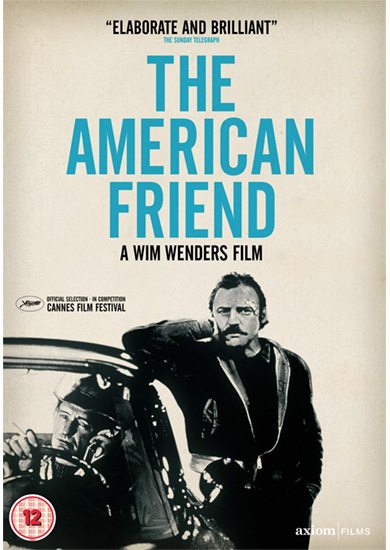
Film Notes
Below is a review of The American Friend – Review by Pauline Kael | Scraps from the loft republished in January 20, 2018
The American Friend – Review by Pauline Kael
Angst-dark primary colors—reds and blues so intense they’re nearpsychedelic, yet grimy, rotting in the thick, muggy atmosphere. Cities that blur into each other. Characters as figures in cityscapes or as exiles in rooms that are insistently not home. And, under it all, morbid, premonitory music. This is the festering mood of the young German writer-director Wim Wenders’s The American Friend, adapted from Patricia Highsmith’s crime thriller Ripley’s Game.
An American demi-crook, Tom Ripley (Dennis Hopper), operating out of Hamburg, suffers a small discourtesy: a Swiss picture restorer and framer, Jonathan (Bruno Ganz), who suspects Ripley of being involved in art forgery, declines to shake his hand. Minot (Gérard Blain), a gangster associate of Ripley’s, needs the services of an assassin, and out of pique—it s no more than a perverse whim—Ripley suggests that Jonathan might be his man. Minot tricks Jonathan, who has a blood disease, into believing that his death is imminent, and proposes that he kill for hire—the target is someone he’s never met—so that he’ll have money to leave to his wife and child. Jonathan’s moral values collapse once he thinks he’s dying; suddenly something in him gives way—as (we fear) it might in any of us. He yields to the momentary temptation, and the trap closes; he’s a criminal. There’s a true thriller moment when this honorable, decent craftsman-shopkeeper carries out his mission. Feverishly, only half consciously, he shoots the victim on an escalator in the Paris Metro and then comes up into the daylight, and it’s like waking from a nightmare—except that we know that now his whole life will be a nightmare.
Highsmith’s thrillers—the sources of Hitchcock’s Strangers on a Train and René Clément’s Purple Noon—aren’t concerned with bringing criminals to justice, and there’s no moral principle or any other standard to separate the normal and the criminal. The symmetrical twist in the plot here is that Ripley develops an affection for Jonathan and tries to extricate him from Minot’s clutches. (Does the title mean that an American friend is one who tries to help you after he’s destroyed you?) Jonathan, who wanted to protect his family’s future, is so changed that he leads a new, dislocated life in which he feels himself a stranger—a tourist who hasn’t got his bearings. His wife barely knows him anymore; Ripley, who understands what is happening to him, replaces his wife as his mate.
Bruno Ganz’s performance as Jonathan is one of the rare ordinary-decent-fellow portrayals that actually succeed (for a while, at least) in involving the viewer. Quiet, a man of inner strength, with watchful, anxious eyes and swansdown diction, Jonathan gives the film its only depth (except for the poignancy of the settings). Ganz doesn’t talk, he croons—and you almost catch yourself leaning toward the screen. You feel you’re reading Jonathan’s soul each time you look at him; you soak into his face the way you soak into the rooms, the streets. If Wenders had written the role so that this patsy had some aggressive impulses that came out in the killing, or if he lost his inner dignity—if he were unpredictable—you could go on soaking into him. But there’s not a lot of variety in Jonathan’s soul. Ganz’s character modulations are in too narrow a range; he’s so inward that you begin to feel he’s looking soulfully out of his deep brown eyes right down at his saintly tradesman’s limp mustache. Jonathan is such a humble, anxious man that the picture needs a counter-force. A stronger Ripley might provide it. But as Dennis Hopper plays him Ripley is nothing but a cowboy hat and a fatigued face and aberrant buoyant flings into the air: Hopper bounds up, arms raised high—the arms that are generally held close in to his slightly rigid body, as if he were chilled.
The psychological union that develops between Ripley and Jonathan—which should be the heart of the movie—is indicated by nothing more than Ripley’s picking up a little kinetic novelty item in Jonathan’s picture-framing shop and Jonathan’s telling him to keep it (a gesture that could signify contempt as easily as generosity). Ripley gives Jonathan a kinetic gadget in return and fastens glassy, sweet-Jesus stares on him, which, by extrapolation, can be interpreted to mean that Ripley is moved by Jonathan’s dedication to his craft. These scenes are particularly awkward because the film’s sound is hollow. The performers speak German or English or French, whichever is appropriate to their characters and the moment, but the sound is poorly recorded and some scenes are inexpertly looped. This technical defect underlines the eccentricity of Hopper’s decaying-juvenile blandness. It takes him an eternity of concentration to perform a minor action, such as pouring coffee into a thermos, and you could drive a truck between the syllables each time he speaks a line of dialogue. Ganz’s accented English is far more fluent than his American friend’s: it’s as if Hopper had just mastered the beginnings of human speech and expected us to share his joy that words come out of his mouth, slowly, but . . . yes . . . they . . . do . . . come . . . out. Even an existential epigram comes out: “I know . . . less and less . . . about who . . . I . . . am . . . and . . . about . . . who . . . anybody . . . else . . . is.” He mutters that into a tape recorder. For posterity. You can’t risk losing thoughts like that. Has the tape been stored in a safe place?
Though Wenders overdoses on mood, he creates the right apprehensiveness for a Highsmith story. But he’s trying to do eighteen other things, too; he “enriches” the plot with incidental speculative themes relating to the oppressiveness of modern society—losing more in clarity than he gains in depth. (It could be argued that he loses more in depth, too.) Jonathan is rootless—an expatriate from Zurich—and the American Ripley, the infant philosopher who talks like the computer in Alphaville, doesn’t really live anywhere; he hops continents (via jump cuts) and camps out in his big house in Hamburg. It features a jukebox and looks like an American Colonial museum of fop Art, so at first you don’t even realize he lives on the same continent as Jonathan. The internationalization of modern cities is another theme: Wenders moves the action from New York to Hamburg, Paris, and Munich, and in each city he shoots the high-rise anonymity that could be anywhere. He finds new’ New Yorks all over Europe, and this certainly makes a point, but in order to make it he deliberately confuses the viewer about where the action is taking place.
All we know about most of the characters in the movie is that they are played by directors. Ripley and Minot are represented by actor-directors (Hopper and Blain), and Nicholas Ray, who directed the young Hopper in Rebel Without a Cause, is cast as a famous painter who has pretended to be dead. He and Hopper have scenes together which, when they become penetrable, seem to relate to the painter’s “forging” new paintings in his old style so they can be sold—a plot embellishment that has nothing whatever to do with Minot and the gangsters Jonathan has got involved with, who belong to porno-filmmaking rings. Other directors who turn up are Samuel Fuller as a Mafia chieftain, Jean Eustache, in a restaurant scene, Daniel Schmid as the man on the escalator, Peter Lilienthal as a hood, and Wenders himself, in an ambulance. This slyboots casting of directors as crooks has a deadening effect; except for Fuller, their acting is perfunctory (and, in the case of Ray, worse, since he tries for a mythic effect). In addition, Jonathans shop and flat contain a magic lantern showing a speeding train, a zoetrope, a stereopticon, a praxinoscope; Jonathan s dedicated craftsmanship is thus linked to moviemaking. Yet none of this film-toy paraphernalia helps to create suspense or to move the action forward; rather, it suggests that though Wenders is attracted to the idea of telling a story he can’t quite keep his mind on it. What about his own pride in craft? The simplest plot points are hobbled, and when there’s mayhem, it isn’t clear who the participants are or what the outcome is. We’re never informed about Ripley’s connection with Minot, which got the whole thing started. There’s a gaping difference between moral ambiguity and this obscurity—which actually impedes the perception of moral ambiguities.
It’s possible for a director to combine suspense narrative and essay, as Godard demonstrated in 1959 in Breathless and in several films in the sixties, doing it quickly, dartingly, in a visual style that could be read at a glance. But Wenders uses densely detailed imagery, his pacing is weighted, and there are no insights that relate to the characters—the film drags along on secondhand alienation. The American Friend doesn’t have the nasty, pleasurable cleverness of a good thriller. Wenders has a moviemaker’s visual imagination, and his unsettling compositions are neurotically beautiful visions of a disordered yet functioning world. Dramatically, though, the entire film is stagnant—inverted Wagnerianism. The unease of the generalized moral degradation overpowers Jonathan’s individual story. Wenders has the style of someone who’s aware of what he’s doing, but that’s not enough—look at Joseph Losev. Wenders is like a more garish, grainier Losey—Losey under mud. Is that why the film is being called a masterpiece? A great many new German films are being called masterpieces. After Vietnam and Watergate, it’s understandable that Americans should begin to wonder if morally we are any different from the Germans, and experience a psychological rapprochement—a new closeness to directors who dredge around in guilt. With nihilism in the air here, the extreme moralism of the Germans may be appealingly exotic. (Moralism could be part of the new attraction of science fiction, too.) American directors may have lost the primitive-visionary qualities that make the new German films so mysterious, but they have an understanding of narrative that the young Germans don’t have. The American Friend is a masterpiece for people who think a movie can’t be worthwhile unless it makes you suffer. Emotionally, the drip drip of Wenders’s poetic urban masochism—which is intended to be antibourgeois filmmaking—is indistinguishable from the heavy-going German films of the Emil Jannings period. Actually, Jannings was a more robust masochist than Bruno Ganz. And Wenders isn’t satisfied by Ganz’s anguish; he also gives Hopper a crackup and a lonely finish. Wenders is not only turgid, he’s exhibitionistically turgid. There’s too much imprecise, darkly lighted desperation in The American Friend. By the time it grinds to a halt, you feel your mind is clouded.
Pauline Kael, The New Yorker, October 17, 1977
Below is a review from the website The American Friend: Little Lies and Big Disasters | Current | The Criterion Collection
The American Friend: Little Lies and Big Disasters.
Haunting, playful, and subtly daring, Wim Wenders’s The American Friend (1977) exemplifies the best of what can happen when one visionary takes as his inspiration the work of another, using it to explore and express his own obsessions.
The film is loosely based on Patricia Highsmith’s Ripley’s Game, and (even more loosely) on another of her novels, Ripley Under Ground. Highsmith’s readers will hardly be surprised to learn that the writer failed to recognize her title character in the Tom Ripley that Dennis Hopper brings to the screen. Highsmith’s heroic villain (or villainous hero) is the perfect sociopath: cool, competent, calculating, highly skilled at evading detection as the corpses pile up in the novels in which he appears—a type one could hardly imagine the tense, impulsive, unpredictable Hopper playing. In fact, Highsmith was initially dismayed with Hopper’s portrayal, though she eventually came around to respecting and liking the film. (Right from the start, however, she admired the balletic staging of the long, chaotic sequence involving some nasty murders on a fast-moving European train.)
As Ripley’s Game opens, Tom is living in rural France with his wealthy French wife and enjoying all the comforts of bourgeois life: buying an expensive antique harpsichord, doing a bit of painting and sketching, planning gourmet meals with the cook. When Jonathan Trevanny, a British expatriate who works as a picture framer and lives nearby, casually insults Ripley at a local gathering, the semiretired con man and killer concocts an elaborate (and delightfully improbable) revenge scheme. His plans involve convincing the framer that the blood disease from which he suffers has grown drastically worse.
Believing that death is imminent, and that he is about to leave his wife and son in dire straits, Trevanny agrees to be a contract killer. In exchange for a large sum that his family will inherit, he will assassinate two mafiosi and (best case!) set off a Mafia gang war that will benefit Raoul Minot, a French friend and coconspirator of Ripley’s, with whom (in Ripley Under Ground) he carried out another scheme to forge and sell paintings allegedly done by a famous artist—now dead.
Such is the frame of the plot. Following it more or less closely, drifting away and then returning to an event from the novel, Wenders radically changes the two main characters. If Highsmith’s Ripley is a cool customer, a fraud and maniac so skilled at what he does that (by the time we catch up with him) he has managed to secure himself an enviable (if ultimately precarious) existence, Wenders and Hopper give us, in Ripley, a hopped-up elf from hell, simultaneously calculating, goofy, and demonic.
We may feel that Highsmith’s interest in Jonathan Trevanny is mostly about how the puppeteer Ripley yanks on his strings. But Wenders portrays Ripley’s victim (here renamed Jonathan Zimmermann, and changed from an Englishman to a German or Swiss German, as we find out) as a tragic figure, a hero for whom we are actively rooting in his struggle against the forces unleashed by the reprehensible caprice of his American friend. How can we not side with a character played by Bruno Ganz at his most radiantly handsome, an actor who can manage to perform the deceptively simple but in fact challenging feat of making a mild and fundamentally decent family man both interesting and charismatic?
We meet Ripley on a cobblestone street in New York’s SoHo, transplanted from Highsmith’s wholly European milieu. As he emerges from a taxi, a siren wails in the background. One trembles to imagine what Highsmith felt when she saw the Stetson hat that the manic cowboy Ripley is wearing, haberdashery that her suave, dapper character would have despised. Played by the iconic director Nicholas Ray (Sam Fuller also appears in the film, as a cigar-smoking American gangster driving an ambulance getaway vehicle), an artist (and forger) named Pogash also has some reservations about the fashion statement made by Ripley’s hat. Up in the old-school SoHo painter’s loft (the sort of space now mostly renovated and inhabited by hedge-fund families), Pogash asks Ripley if he wears that hat when he’s back in Hamburg. Hopper takes off his hat and examines it as if he’s never seen it before. He asks, “What’s wrong with a cowboy in Hamburg?” Nothing and everything, as it turns out.
Throughout his career, Wim Wenders has been fascinated, even obsessed, by America: its landscapes, its citizens’ faces, the way the country sees itself and is seen by the world, its reality and its myth. Ripley’s Stetson identifies him as mythically American, so it’s ironic and odd and funny that America—in theory, a beacon of democracy and culture—appears here as a rather dim beacon: a not very intelligent psycho, with a calculating nature and a gift for intimidation that may remind us of the crazed, gas-sucking bully Hopper would play in David Lynch’s Blue Velvet.
The camera follows Ripley back to his mansion in Hamburg, a limestone extravaganza seemingly built for some decadent or possibly mad Habsburg prince. In fact, Ripley’s a bit excessive himself; in one peculiar and striking scene, we look down on him in bed, dressed in a khaki jumpsuit and lying on sheets the garish tangerine color of drugstore lipstick.
Elsewhere in Hamburg, we meet Jonathan Zimmermann, walking with his small son Daniel. In Wings of Desire, which Wenders made a decade later, Ganz plays an angel, and a halo already surrounds the sweet-natured picture framer. He’s so good he can’t bring himself to chase down an old woman who underpays him, so polite he gives Ripley a trick photo (move it and the face wiggles) to apologize for having been rude after an art auction during which one of Ripley’s fakes sold for a very high price. That the painting is slated for resale in Texas, where it will fetch a small fortune, is ironically meant to ameliorate the crime.
Ganz’s Zimmermann is so solid, so vital and shyly forceful, anyone could tell him that he isn’t as sick as Ripley is trying to make him think. In fact, the doctors do tell him that, but Ripley and his evil friends are more persuasive. We can only hope for the best as we watch the framer make one wrong decision after another—his actions based, of course, on critical wrong information. Ganz makes us feel that he is behaving exactly as we would in his situation—wanting to know everything, hoping for good news and fearing the worst. Spouting hackneyed philosophical blather (“There is nothing to fear but fear itself”) into a tape recorder, looking, in his cowboy hat, like a demented James Dean, doing a funny little dance on his majestic terrace, sprawled on his tangerine sheets, Ripley is pure trouble—a bomb exploding in Zimmermann’s life.
The film contains plenty of action and suspense, of mayhem and murder, but it goes deeper than crime, than noir; we feel that we are watching a sort of primal duel. It’s a little like Henry James in reverse: the jaded American corrupting the innocent European. And though we sympathize with Zimmermann, we also become almost complicit in that corruption, as fascinated as Ripley is by how the framer overcomes his conscience and agrees to do things that would have been unthinkable before.
When Raoul Minot explains that they need one or maybe two people eliminated, Ripley objects for as long as it takes Minot to remind him of their shared criminal past—about ten seconds. Zimmermann holds out for much longer. There is a beautiful scene in which he thinks that Minot is mistaking him for someone else, or joking. His reluctant transformation is at once Shakespearean, noir, and soap-operatic; the nakedness of his pain brings to mind a Teutonic Almodóvar character.
When Zimmermann receives his first assignment to commit murder, he is told that his intended victim is an American Jew. In fact, the guy he is supposed to kill looks less American than French, with a long, sad Semitic face—a hit man who resembles Marcel Proust. I can’t remember whether, the first time I saw the film—shortly after it was released—I registered the intense, nervy, slightly wicked achievement of making someone like me (an American Jew) hope that a German would kill the American Jew and get away with it. Again, it’s the power of Wenders’s direction and Ganz’s performance that so thoroughly reorganizes our moral and historical sympathies. How squarely we have been put on Zimmermann’s side, fearing for his safety as, after the semibotched assassination, he keeps tripping over things and smashing into the walls of the metro station.
If all this is not reason enough to watch The American Friend, there are plenty of others. The settings are fantastic, not only Ripley’s mansion but the Hamburg waterfront neighborhood where Zimmermann lives with his family. (Wenders has always had an unerring eye for the expressiveness of architecture and landscape.) The scenes of violence and mounting paranoia are as skillfully shot as anything in Hitchcock. We feel the film is at once rigorous and free to interject an unexpected shot: there is a striking, almost startling cartoon of a vintage moving train that not only prefigures the railroad horrors to come but appears on little Daniel Zimmermann’s bedside lampshade. Later Daniel and a friend play with a zoetrope, that early animation device featuring a drum lined with slits, through which one looks at images on the inside as the drum turns and animates them: here, a cartoon of a figure jumping through a hoop held by another figure. There is a visually magnificent scene in which Zimmermann is playing with a sheet of gold and winds up gold-leafing his hand. And then we have the excellent soundtrack, a characteristic of Wenders’s, who has also made some of the very best documentaries about music and dance, Buena Vista Social Club (1999) and the brilliant Pina (2011), a study of the Pina Bausch dance company. Here the music ranges from a lush, Bernard Herrmann–like score to something like the ethereal chimes we can play on our iPhones.
Images and scenes stay with us, layering over our memories of the Highsmith novel, forming a unique pentimento. In a letter to Andrew Wilson, author of Beautiful Shadow, a biography of Highsmith, Wenders wrote, “Her novels are really all about truth, in a more existential way than just ‘right or wrong.’ They are about little lies that lead to big disasters. As I am really obsessed with the idea of ‘truth’ and ‘beauty’ being identical notions, you can imagine I was attracted by Highsmith’s own preoccupations.” Like Highsmith, Wenders has always been preoccupied with nationality, with the differences between Americans and Europeans, and with the effects of place. But above all, truth and beauty are what he has gone for and achieved in this stylish thriller, really and truly noir in its power to make us feel that we are watching something epic and spiritual play out in a very dark way, on a fast European train.
Francine Prose, The Criterion Collection, Jan 12, 2016
Copyright © 2016 by Francine Prose. All rights reserved.
What is F-Rated?
The F-Rating is applied to all films which are:
- Directed by women
- Written by women
- Has one or more significant women on screen

If it qualifies with one of the above it gets the Bronze rating.

If it qualifies with two of the above it gets the Silver rating.

If it qualifies with all three of the above it gets the Gold rating.
What is F-Rated?
The F-Rating is applied to all films which are:
- Directed by women
- Written by women
- Has one or more significant women on screen
If it qualifies with one of the above it gets the Bronze rating.
If it qualifies with two of the above it gets the Silver rating.
If it qualifies with all three of the above it gets the Gold rating.