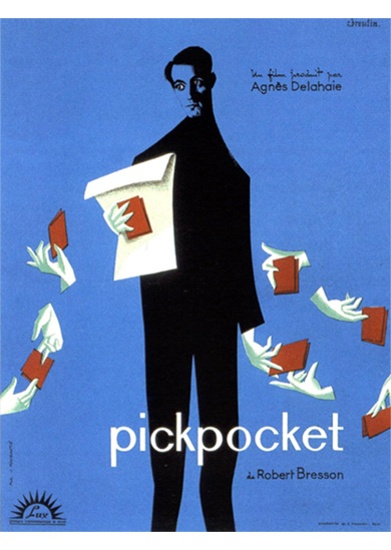
Pickpocket
Michel passes the time by picking pockets and is careful not to be caught despite the attentions of the police. His friend Jacques may suspect what Michel is doing. Both men have their eyes on Jeanne, the pretty neighbour of Michel's ailing mother.
Film Notes
Less is most definitely more in the late Robert Bresson's brilliantly pared-down and powerfully austere study of a compulsive pickpocket Michel (Martin Lassalle), who achieves an unlikely redemption through the love of a sympathetic woman (Marika Green). Shot in 1959 on the streets of Paris, and the first of the French director's films not to be an adaptation of a literary text, it features a cast of deliberately inexpressive non-professional actors.
"My feet no longer touched the ground. I dominated the world," explains Michel after his first theft from a lady's handbag at a racetrack. And it's the desire to recapture this ecstacy rather than any material gain, which propels the protagonist on his self-destructive path.
"A DREAM-LIKE QUALITY"
The fetishistic way Bresson films the pickpocketing sequences confers an erotic dimension upon Michel's criminal activities, with the camera lingering on hands and faces, and recording the way fingers dip into jacket pockets to retrieve wallets and money. A breathtakingly choreographed sequence at the Gare de Lyon has Michel and his accomplices working their way through a crowd, passing the stolen valuables to one another with sublime dexterity.
There's a dream-like quality to the monochrome Pickpocket, which lasts for just 75 minutes: it's impossible to gauge how much time passes between sequences, whilst Bresson uses sound and music sparingly to heighten the mysterious atmosphere. If the ending in which a sinner finds salvation seems familiar, it may be because Paul Schrader, the author of a famous book on Bresson, pinched Pickpocket's finale for both American Gigolo and Light Sleeper.
Tom Dawson, BBC Films, Updated 03 April 2005.
the following is from a French webpage.Pickpocket by Robert Bresson (1959) - Film review and analysis - DVDClassik
History
« This film is not in the detective style.
The author strives to express, through images and sounds, the nightmare of a young man driven by his weakness into a pickpocketing adventure for which he was not suited.
Only this adventure, by strange paths, will bring together two souls who, without it, would perhaps never have known each other. »
Analysis and criticism
When Bresson wrote his first original screenplay for Pickpocket, he did not immediately realize the relationship that was being forged between him and Dostoyevsky. It was only after realizing the links between Raskolnikov's and Michel's careers that he decided to accentuate them and make his film a kind of echo of Crime and Punishment. We see in this anecdote that Bresson does not see himself as an omniscient creator, but rather that he searches, that he gropes, that he seems to discover his work as it is created. Certainly, the shadow of Dostoyevsky hangs over Bresson and their meeting seemed obvious. Like the filmmaker, the writer digs into the very material of his art in search of the soul of his characters. With A Gentle Woman in 1969 and Four Nights of a Dreamer in 1971, Bresson adapted Dostoyevsky directly.
Louis Malle: "Pickpocket is Bresson's first film. The ones he did before were just drafts. If it was eight years earlier, for Le Journal d'un curé de campagne, that Bresson began to see clearly what cinema should be for him and the means that led to it, it was really with Pickpocket that Bresson gave himself completely over to his cinematograph, marking the culmination of the research for the Journal and Un condamné à mort s'échappé. If Léonce-Henri Burel signs the photography of these three films (succeeding Philippe Agostini), his work on Pickpocket is totally in line with Bresson's wishes. As magnificent as it is, the cinematography is flattened, completely abandoning the few formal research sketched out on previous feature films. For The Condemned One, Bresson had completely abandoned the original music (Jean-Jacques Grünewald had until then signed the scores of his films) in favor of Mozart. Lulli follows his Mass in C minor, and the musical passages become more parsimonious, no longer really supporting the strong scenes of the film. This search for counterpoint is still in its infancy, but Pickpocket once again marks a definitive break. Having become the complete author of his film, after having adapted Diderot and Bernanos, worked with Giraudoux and Cocteau, or having been inspired by a true and morally striking story for The Condemned Man, Bresson freed himself from the "good subject", from a "literary" cinema. He doesn't choose a strong story and builds his film on sensations, emptiness, repetition, silence. It is by purely cinematographic means that he will make the viewer feel the subject, the characters, the moral.
We don't know the reasons that led the hero to steal and we never see him use the fruit of his thefts. He still wears the same worn suit, still lives in a dilapidated attic. "We must not film the causes, but the effects." This succession of thefts leaves us speechless. There is something unspeakable in these acts, obscure. And it is through his mise-en-scène, without the help of speeches, that Bresson will make us feel the heart of the film. Feeling before understanding. The flight scenes are relentlessly powerful. A suspense, an incredible tension runs through them. Anguish grips us throughout the film. Pickpocket is a film of looks and gestures. Wallets are passed from hand to hand in a veritable ballet. Thus the scene at the station is completely euphoric. We feel the tension, but at the same time the enjoyment of the successful flight. We are filled with chills, fear and pleasure mixed. It is a rare sensory experience to which the filmmaker invites us. Pickpocket is perhaps the film that best captures the pleasure of theft, of transgression. "What he got from a rookie is a miracle. For, not only has he trained long hands to hide portfolios that could be those of a pianist, but he has also communicated to his hero the kind of terror of being an animal that watches for its catch and fears to be watched by it. (Jean Cocteau about Pickpocket, in Du cinématographe). It is also, like the majority of Bresson's films, a magnificent portrait of youth. Through Michel's itinerary, Bresson describes the world in which we live when we leave adolescence and enter adulthood. These thefts to which he indulges are an act of revolt, a rejection of society. And yet one senses that beneath these acts of rebellion, there is a constant desire to find one's place in the world. The purpose of Michel's crimes is to be caught. "Robert Bresson shows us, without the slightest artifice of intrigue, the vertigo that pushes the thief into the lion's mouth and the forces of love that pull him out despite the bars of his cell." (Jean Cocteau on Pickpocket, Du cinématographe). Michel locks himself up in this activity, consciously withdraws from others and from the world. When he asks his friend if he loves Jeanne, and if she loves him back, instead of reacting to this revelation, he clutches the watch he has just stolen. "The watch was very beautiful." He built himself a real rampart.
The emotion of flying is then much stronger than the emotion of love. "I wanted to make it palpable that the paths we take in life don't always lead to our destination. I mean to the intended destination. While Michel does everything he can to isolate himself, as his life shrinks, reduced to his small apartment and repeated gestures, the path he takes will, if he realizes it, bring him into the world. The character of Jeanne is this path, from annoyance to jealousy, from rejection to responsibility, until the revelation of her love enlightens and saves him. If man is indeed at the heart of the filmmaker's work, his main concern, the question of God, is constantly evoked. Pickpocket is the perfect illustration of this, as Louis Malle mentions in a magnificent article on the film. Michel is the man who revolts, proud. In a speech to the Chief Inspector, he set out his theory of superior beings, who would be above the law. It's like hearing Brandon Shaw in Hitchcock's The Rope. Michel wants to transgress the prohibitions, to confront God. This God is the Inspector, omnipresent, indulgent and terrible. Jacques is the guardian angel. And Michel's journey leads him to the divine grace that takes on the face of Jeanne. This one is very pale at first, self-effacing, quite insignificant. But slowly, without explanation, it takes on an inner beauty, it shines and becomes sublime.
Human, spiritual or moral, Pickpocket is a journey, a journey. Michel's last flight responds to the first. Same place, just a reversal of Michel's position as he goes from behind his victim to the front, a position in the image that locks the hero in the time of the film. A position that also makes his journey in the film inevitable but which at the same time gives him a special status, a parenthesis in Michel's life. It will really resume at the end of the film at the moment when his story with Jeanne begins. Pickpocket is a simple foreplay, a dream, a dream.
Olivier Bitoun - DVD Classic, May 4, 2005
What you thought about Pickpocket
Film Responses
| Excellent | Good | Average | Poor | Very Poor |
|---|---|---|---|---|
| 20 (34%) | 12 (21%) | 17 (29%) | 9 (16%) | 0 (0%) |
|
Total Number of Responses: 58 Film Score (0-5): 3.74 |
||||
Collated Response Comments
117 members and guests attended the screening of Pickpocket. We received 58 responses giving a film score of 3.74 and a response rate of 50%.
All of your comments and observations are collected below.
“Just the type of film GFS should be showing. Very rewarding to see the protagonist finally realising what he has been missing in life, his soul. More classics like this please”
“I would rate this film as poor. Whilst I enjoyed seeing the stylishness of Paris in the late 50’s (particularly the women who all looked like fashion models) the woodenness of the acting jarred with me and cancelled out any feeling of empathy with the main characters”.
“A difficult film to rate - very much of its time and country, production-wise, and clearly can't be usefully compared with modern movies or their production values. The Black-and-white film and underlit settings all added to the postwar gloom, desperation and poverty portrayed. I always enjoy seeing new film styles, and this was no exception, but I feel I've ticked that (style) box, and don't think I need to repeat the experience (Film committee: take note). The music was well done, though"
“The small, sad, grey inner and outer world of the addict is explored relentlessly including the moments of euphoria that drive the addiction. I don't think that there is redemption and a new beginning at the end of the film. The grille through which they kiss and caress stands for the addiction that he has not overcome yet”.
“What an extraordinary film is Pickpocket. The story of a compulsive gambler, gambling mostly that his skills as a pickpocket will allow him to avoid detection, and ending in a way that suggests he wished to be caught. And then his redemption comes from the love of Jeanne! All of this is played by the actors with almost no facial expressions. The photography was often wonderful to watch and the scenes of the gang on the train, slipping wallets out of pockets and along a human chain - even on one occasion to reinserting the wallet, emptied of cash, back into the owner’s pocket. It was quite balletic”.
“Classic cinema - entrancing, painterly, each shot carefully composed, the sound of the film as important as the look of the film”.
“The short was also very good”.
“Not always easy to follow the story line nor understand his motivation to be a pickpocket rather than earn an honest living. Station scene was very slick and a good reminder to us all to be careful! Rated as Average but another interesting choice. Thanks.”.
“So many ideas and possibilities in Pickpocket, it seemed hard to pin anything down. Pickpockets in stations almost mesmerizing in movement this 'dance' intensified by the percussive soundtrack of heels on the station floor, the sliding of train doors back and forth. Almost takes one back to silent cinema with marks of French 'nouvelle vague' Thought that immersing the audience in the world, the mindset, and even the body of a thief tries to point to possible redemption was striking. It moves beyond a story about virtue, moral decay with carefully set up scenes. The lingering glances add to the tension of how Michel's sleight of hand lifts the film to the level of something almost mysterious. The more structured scenes seem to make petty crime peculiarly attractive. Reminded me of Crime and Punishment – criminal acts, prison yet Michel's life softened by love. Is the mixture of the spiritual and the material a contradiction at work? For all the emphasis on precision and control, chance is a key element in the film. Liked its emotional intensity; thanks for showing this and the engaging bright short!”
“Short and very sweet. Still thinking about the film”.
Comment on the short film…. “Cohabiting couple trying to cope with living together yet showing no respect of each other's boundaries. Poor entertainment value!”
“A protracted dull storyline desperately waiting for a glimmer of action”.
“Enjoyed it despite myself. Amazed at how stylised it was. Haven’t seen anything this minimalist before!”
“Loved the soundtrack and photography. Mesmeric”.
“Short was odd”.
“Intriguing and fascinating. Looked beautiful. (the short was well done but the premise was misogynistic I found)”.
“Finnish short film was good/excellent. I do enjoy minimalistic films – do again excellent”.
“Not sure! Couldn’t really engage with it. Liked the b&w filming”.
“Either very excellent or very poor. Difficult to judge 70 years later!! Predictable end. The acting style too bland. Learned a lot about picking pockets”.
“Very atmospheric, evoking the spirit of Parisian life very well. Very drole!”
“Interesting theme throughout of right and wrong”.
“Very interesting. Great actors and actresses’”.
“Certainly different – strange indeed. Interesting that the accommodation was so poor! P.S. the short was awful – far too obvious”.
“Amazing acting for first timers. But at times a very odd story”.
“So, it was a love story!” “Confusing”.
“Slow paced and I didn’t get it. Some of the acting was good. Atmosphere in a French way”.
“At least it was short! Too hot!”
“The whole film seemed flat. No emotion showing on their faces. Who chose it”.
“Enjoyed the cinematography and the depiction of Paris in the late 50’s. But overall, it didn’t live up to my elevated expectation of a Bresson”.
“The views out of the windows were fascinating as were the stairwells and women’s fashion. I couldn’t understand why Michel wasn’t richer and got a new suit”.
“Very French! I was more interested in the period clothing than the plot. Somewhat pointless storyline”.
“Very of s bygone era of French cinema! Slow, moody, lacking in anything to really get excited about!!!”
“Very slow”. “Not for me”. “Boring”. “Why”.
“At least it was short! I kept waiting for some drama…….it didn’t come”.
“So dull. I kept looking at my watch to see if I could go”.
“Glacial, deadpan boring”.
“Slow plot. Stange and dull really, though very stylised filming and nice music”.
“The film felt flat and monotonous as it went on; I think because he showed no emotions and the music was also a bit lifeless. But the techniques were interesting and hopefully saves me from a thief”.
“Wooden acting!!! Couldn’t wait for it to end and put me out of my misery!”
What is F-Rated?
The F-Rating is applied to all films which are:
- Directed by women
- Written by women
- Has one or more significant women on screen

If it qualifies with one of the above it gets the Bronze rating.

If it qualifies with two of the above it gets the Silver rating.

If it qualifies with all three of the above it gets the Gold rating.
What is F-Rated?
The F-Rating is applied to all films which are:
- Directed by women
- Written by women
- Has one or more significant women on screen
If it qualifies with one of the above it gets the Bronze rating.
If it qualifies with two of the above it gets the Silver rating.
If it qualifies with all three of the above it gets the Gold rating.