The Stranger
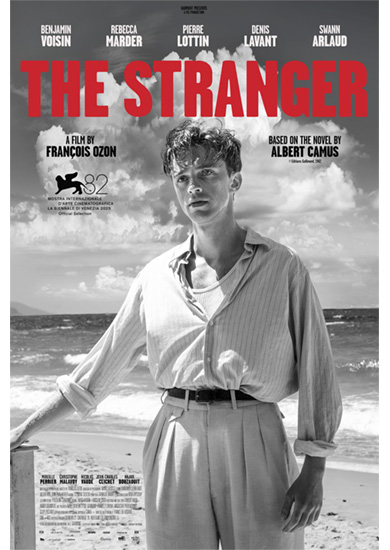
Francois Ozon's adaptation of Albert Camus's 1942 novel The Stranger, which centres on a detached and indifferent Frenchman in 1930's French Algeria, whose daily life is changed by the death of his mother and a fateful encounter on a beach.
Film Notes
‘The Stranger’ Review: François Ozon Adapts the Camus Classic into a Sharply Cinematic Enigma
Rising French star Benjamin Voisin delivers a superb portrait of disaffection in a bracingly lossless transfer of book to screen that relishes the novel's menace and mystery.
Confounding, disturbing and yet icily compelling, the experience of watching François Ozon’s “The Stranger” is not entirely dissimilar to that of reading Albert Camus’ 1942 classic. Wisely, Ozon only rarely goes beyond the text; instead he invests signifiant creative energy into mimicking the affectless but oddly seductive tone of the novel in purely cinematic terms. So the gaps between Camus’ crisp, declarative sentences become the slivers of time lost to the cuts between coolly choreographed scenes. And the book’s bracingly straightforward descriptions of often inexplicable behaviors and thought processes, become the hard, stark edges of a sculptural black-and-white photography that is all the more mysterious for apparently having nothing to hide.
Embodying the enigma at the heart of it all is Benjamin Voisin, playing Meursault, a character who famously kills a man on a beach mere days after attending the funeral of his mother, at which he did not cry. And Voisin is superb in a role that reunites him with the director after breaking out in Ozon’s “Summer of 85,” but that requires him to play in a radically different register, all withholding, stiff-backed self-containment. It is not easy to make the void-like absence that is the crux of Meursault’s being register on screen as a presence. But Voisin’s Meursault, for all he has some chameleonic, Ripley-like qualities — change the angle, or the parting in his hair and he can look like a wholly different person — is consistent in the unnerving steadiness of his gaze. (As an aside it’s interesting to read that Ozon laments the casting of Mastroianni in Visconti’s 1967 version of Camus’ book and wishes it had been Alain Delon; Delon’s first major role, of course, was as Tom Ripley in René Clément’s “Purple Noon.”) But Meursault is no sociopath. He never manipulates. He never lies.
The most striking non-textual indulgence Ozon allows himself comes at the very start. After the vintage Gaumont logo flashes up, we get a brief, rich montage of archival footage of 1930s Algiers. An excitable announcer trumpets the virtues of this beautiful, fun-packed place with all the gusto of a tour guide, while upbeat gramophone music plays. But even while he’s still chirping away, the mood of the images changes. A group of Arabs stare hostilely at the camera. A wall is graffiti-ed with “National Liberation Front.” Elsewhere a group of white residents hold up banners declaring their — and Algeria’s — allegiance to France. (Algerian independence would not happen for another three decades.) As the music becomes Fatima Al Qaddiri’s score, with its clever commingling of modern and classical elements, these grittier images segue seamlessly into our introduction to Meursault, who is being thrown into prison. One of his fellow convicts asks him what he’s in for. Eyeing him levelly, aware that he is probably the lone white guy in the entire overcrowded dungeon, Meursault enunciates clearly: “I killed an Arab.”
Like the book, the film is divided in two, with Part One dealing with Meursault’s mother’s funeral and the torpid days of sunshine, surf and sex that follow it. With Clément Selitzki editing at an unhurried pace — which comes to feel like the episodic way Meursault experiences time, without much sense of causality between one day and the next or one event and the next — we accompany Meursault on his trip to the elder care home where his mother’s body is being prepared. He does not want to see the body. He does not speak to the other residents. And, of course, he does not cry, all throughout the vigil he maintains over her coffin the night before interment. After the service, he goes to the beach.
There, with DP Manu Dacosse’s slicingly clean and lovely monochrome photography revelling in the creamy waves, the high-sun shadows and the seawater clinging to Voisin’s skin, he meets Marie (a terrific Rebecca Marder, all luminous looks, sensuality and self-deception) and arranges to go with her to a comedy playing at the cinema later. (It’s 1938’s “Le Schpountz” aka “Heartbeat,” starring Fernandel who is namechecked by Camus). She laughs, he does not. But he does get to feel her up and later they have sex, after which Marie falls lightly in love in him, and wants to marry. Meursault acquiesces but with a casually brutal frankness as to his motives, which have nothing to do with love.
Meanwhile Meursault’s friend Sintès (Pierre Lottin), a nasty bit of work rumored to be a pimp, has been beating his Arab mistress Djemila (Hajar Bouzaouit) and is being threatened by her brothers. And his gruff and scabbed old neighbor Salamano (Denis Lavant) has been beating his dog, but weeps and tells sentimental stories of it when it runs away (if this is not quite the role Denis Lavant was born to play, then it certainly feels like one that was just waiting until he aged into it). Violence, especially by men on the creatures they believe to be inferior to them, is in the Algerian air. Perhaps that is what rushes in to fill the vacuum where Meursault’s morality ought to be. Or perhaps, when he pulls that trigger later on that beach and thus ushers in Part Two, which deals exclusively with his incarceration, it’s just a coin toss, an idle curiosity, a trick of the light.
The major achievement of Ozon’s film is to adapt literature without literalizing (there are just two snatches of narration that are directly lifted from source), and to honor the novel’s mystery without trying to solve it. His bolstering of the female characters, with Djemila and especially Marie given richer notes to play than the first-person narration of the book ever allowed for, is certainly welcome, as is the naming and personifying of the victim who is only ever referred to as “The Arab” by Camus. And his evocation of the specific political environment of pre-war Algeria is an intelligent contemporary expansion on the novel. But in the more fundamental sense Ozon changes very little and so preserves the narrative’s timeless appeal: As he has always been in the book, the Meursault of the film remains magnificently resistant to diagnosis or psychologizing. How comforting it would be to be able categorize his condition and take appropriate steps to immunize ourselves from it! How comforting and how false, and there is little comforting about Ozon’s detached, dreamily dissociated “The Stranger” except perhaps the glimpse it grants us into the abyss, from which we can pull back into the tender indifference of the world.
Jessica Kiang, Variety, Sep 2, 2025
‘The Stranger’ review: Francois Ozon adapts 1940s Algeria-set novella into artful character study
Black-and-white Venice Competition title is adapted from Albert Camus story and stars Benjamin Voisin and Rebecca Marder
Published in 1942, Albert Camus’ novella L’Etranger (translated variously in English as ‘The Stranger’ or ‘The Outsider’) never gets old. Francois Ozon’s adaptation is at its best when it sticks to the letter and tone of Camus’ enduring, enigmatic novella, about a young settler in 1930s Algiers who engages in a love affair before murdering a stranger. Shot in moody, period-appropriate black and white, and casting young French actors Benjamin Voisin and Rebecca Marder, the film has an alluring, zeitgeisty quality that should, despite some problems of tone and balance, secure decent arthouse results following its premiere in Venice competition.
Remarkably, given the succinct clarity of a novella that unspools as a series of stark, easily visualised scenes, Camus’ book has only been adapted with any degree of faithfulness once before – in 1967 by Luchino Visconti, with Marcello Mastroianni in the role of the film’s ‘hero’. Viewed today, that film feels pretty radical, because it withholds audience sympathy from Meursault (played here by Voisin) – the French functionary who, in the novella, kills a young Arab man for no apparent reason.
Ozon can’t – or won’t – do that, so his task becomes more complex: to make us feel for a man who doesn’t emote much, a man who when asked in court what he now feels about the murder he committed, replies: “a certain ennui”. It’s a task made all the more complex by the cultural and political ramifications of the modern world. The director’s attempts to take this issue on board – for example, by giving a name and a weight to the character of the dead man’s sister, only briefly glimpsed in the book – don’t quite convince, because Ozon cannot afford to turn Meursault into a racist, or an instrument of colonial oppression.
Yet for most of its running time, until a stretched final 20 minutes, The Stranger is a reasonably absorbing study of a man for whom everything seems to mean less than zero. As written by Ozon and played by a convincing Voisin (who shot to attention in Ozon’s Summer of ’85), Meursault is not your standard-issue sociopath. He’s a withdrawn observer, one who seems content to let life happen to him, who acts only when prompted.
At his mother’s funeral, he does everything required of a dutiful son – except to show anything resembling sadness or grief. The next day, he goes to a beach club, where he meets up with Marder’s secretary Marie, takes her to the cinema to see a comedy, and embarks on a sexual relationship – one shot, in true Ozon style, with a crackling yet tasteful erotic charge. He also interacts with two neighbours. One is Denis Lavant’s Salamano, a withered, lonely old man disconsolate after the loss of the dog he maltreated while it was alive. The other is a boorish, manipulative pimp played with sweat-stained authenticity by Pierre Lottin, whose abuse of his Algerian mistress will precipitate the crime at the centre of the film.
That occurs around the mid-point – and it comes with a brief hint that there may be a homoerotic motive, one that feels gratuitous because it is neither anticipated nor pursued. The second part of the film traces Meursault’s incarceration and trial. Ozon suggests – particularly through a scene in which a prison chaplain (Anatomy Of A Fall’s Swann Artaud) encourages the condemned man to embrace God – that there is a kind of heroism in nihilism, in staying true to yourself as you stride towards oblivion.
Like George Washington, Meursault cannot tell a lie. His contempt of the hypocrisy of a society that will condemn a man to death for not crying at his mother’s funeral is noble; his comment to a policeman that he’s rather looking forward to his trial because he’s never witnessed one before is weird. That chilling anomie keeps undermining the touch of martyrdom that Ozon brings to his central character (who in prison becomes Christ-like even in appearance as his hair and beard grow out).
On his fifth film with Ozon, Belgian cinematographer Manu Dacosse brings a love of texture, of surfaces, shadows and skin, to a story often recalled as a cerebral literary exercise. Grates, prison bars, latticework skylights and the shadows they cast – the camera notes these details just as Meursault does. A beetle on top of a wall is as worthy of attention, for him, as a pretty woman or a prosecuting magistrate. An atmospheric ambient soundtrack by Kuwaiti musician Fatima Al Qadiri laps around the edges of the action, reminding us that these strange colonial incomers are in a strange land.
Lee Marshall, Screen Daily, 2 September 2025
What is F-Rated?
The F-Rating is applied to all films which are:
- Directed by women
- Written by women
- Has one or more significant women on screen

If it qualifies with one of the above it gets the Bronze rating.

If it qualifies with two of the above it gets the Silver rating.

If it qualifies with all three of the above it gets the Gold rating.
What is F-Rated?
The F-Rating is applied to all films which are:
- Directed by women
- Written by women
- Has one or more significant women on screen
If it qualifies with one of the above it gets the Bronze rating.
If it qualifies with two of the above it gets the Silver rating.
If it qualifies with all three of the above it gets the Gold rating.