The Spirit of the Beehive
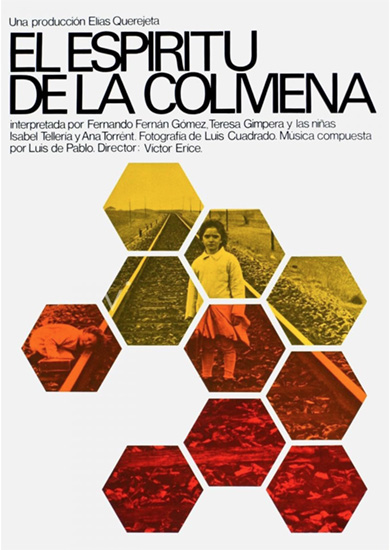
In post-Civil War Castilla, a travelling movie theatre brings James Whale's black and white classic Frankenstein to a small village. Two young girls, Ana and her sister Isabel, are fascinated by the film and are determined to find the monster themselves.
Film Notes
Victor Erice: The Spirit of the Beehive.
I once showed a dozen or so classic non-American films to students at the Royal College of Art. To my surprise, despite the fact that the list included the work of such world-renowned directors as Luis Bunuel, Satyajit Ray and Kenji Mizoguchi, the film they fell in love with was Victor Erice's The Spirit of the Beehive. They rightly thought it close to magic. It is one of the most beautiful and arresting films ever made in Spain, or anywhere in the past 25 years or so.
Set in the Castillian countryside around 1940, when Franco had won the civil war but was still hunting down republican sympathisers, and made in 1973 when it was necessary for Spanish film-makers to cloak their political messages in allegory, it has an eight-year-old girl called Ana, superbly played by Ana Torrent, as its central character.
She watches James Whale's Frankenstein at the local cinema and can't understand why Frankenstein kills the little girl he meets and seems to cherish by the lakeside. Her elder sister, Isabel (Isabel Telleria), explains that nobody actually dies in movies. But she adds that the monster is really a spirit who can take on human form and can be summoned up by closing your eyes and calling out: "I'm Ana". She has seen him in a deserted outhouse near the village.
Ana is detemined to invoke the spirit. Going across the deserted fields to the outhouse, she finds a republican fugitive and brings him clothes and food. For her, he is Frankenstein and even though he is shot by the civil guard, she is certain spirits don't die and dreams that she meets him, like the little girl in Whale's film. Brought back home by her distracted parents and put to bed, she goes to her bedroom window and whispers: "I'm Ana, I'm Ana."
The film can be construed in many ways but is, above all, an almost perfect summation of child hood imaginings. It is also about the pall Franco's long shadow left over Spain. Ana's father, played with understated power by Fernando Fernan Gomez, has evidently been traumatised by the civil war and is a shadowy figure writing a treatise on beekeeping while his wife writes letters to a would-be lover, exiled in France. They are a family "locked up in themselves", unable to avoid the terrible emotional consequences of the civil war and the absolute triumph of dictatorship.
The film is thus cloaked in quiet and sadness, through which its children move almost as if in a dreamworld of their own. It is brilliantly shot by the great Luis Cuadrado in atmospherically muted colours: the series of dissolves with which he denotes the passing of time outside the makeshift cinema where the children see Frankenstein provides one stunning sequence, but there are many.
Few know that Cuadrado was going blind at the time, which makes his work all the more remarkable. There is also a memorable score from Luis de Pablo, which sums up everything while underlining nothing. It is virtually impossible to get the sight and sound of the film out of one's mind after watching it.
But, of course, it is chiefly Erice's film - a perfectly controlled and imagined first feature so painstakingly made that Elias Querejeta, one of Spain's most enlightened producers, worried that it would never be completed. To date, Erice has made only two more films: South, which is merely half a story, never completed, and The Quince Tree Sun, one of the most extraordinary films about painting ever conceived. He is now working on another one, late as usual.
Derek Malcolm, The Guardian, 16th September 1999.
“Everything in the movies is fake”
In a vast Spanish plain, harvested of its crops, a farm home rests. Some distance away there is a squat building like a barn, apparently not used, its doors and windows missing. In the home lives a family of four: two little girls named Ana and Isabel, and their parents, Fernando and Teresa. He is a beekeeper, scholar and poet who spends much time in his book-lined study. She is a solitary woman who writes letters of longing and loss to men not identified. The parents have no conversations of any consequence.
It’s an exciting day in the village. A ramshackle truck rattles into town announced by scampering children, who shout, “The movies! The movies!” A screen and projector are set up in the public hall, and an audience of kids and old women gather to see “Frankenstein” (1931).
For the children, the movie had might as well only be about the monster, so tellingly performed by Boris Karloff. The creature comes upon a farmer’s young daughter tossing flowers into a pond to watch them float. Perhaps because of censorship, the film cuts directly from this to the monster mournfully carrying the child’s drowned body through the village. Perhaps because of censorship, we don’t see that he did not drown her, but threw her in with delight, thinking she would float as well. For the two girls, especially Ana (Ana Torrent), this makes a dramatic impression.
Her misunderstanding of the scene will shape the events to follow in Victor Erice’s “The Spirit of the Beehive” (1973), believed by many to be the greatest of all Spanish films. Although the time is not specified, it would have been clear to Spanish audiences that the film is set soon after the end of the Spanish Civil War, which began Franco’s long dictatorship — so soon after that the same day, a wounded opponent of the regime takes refuge in the barn-like outbuilding.
Only a few years separate Ana and Isabel (Isabel Telleria), but they form that important divide where Ana depends on her big sister to explain mysteries. The little girl runs carefree all over the farmlands, and in the barn she discovers the wounded soldier. That night, her eyes wide open in the dark, she asks Isabel to explain why the creature drowned the little girl. “Everything in the movies is fake,” she’s told. “It’s all a trick. Besides, I’ve seen him alive. He’s a spirit.” That of course serves for Ana as a possible explanation for the wounded man, and the next day, she sneaks him some food and water, and her father’s coat.
What follows is considered a coded message about Franco’s fascist regime, but it’s not for me to connect the dots. I relate to it more strongly as a poetic work about the imagination of children, and how it can lead them into mischief and sometimes rescue them from its consequences.
“The Spirit of the Beehive” is one of only three features and a short subject directed by Erice (born 1940). Like such films as Charles Laughton’s “The Night of the Hunter” (1955), it is a masterpiece that can only cause us to wonder what we lost because he didn’t work more. It is simple, solemn, and in the casting of young Ana Torrent, takes advantage of her open, innocent features. We can well believe her when she accepts her sister’s explanation, which goes far to account for her behavior later in the film.
This is one of the most beautiful films I’ve seen. Its cinematographer, Luis Cuadrado, bathes his frame in sun and earth tones, and in the interiors of the family home, he creates vistas of empty rooms where footsteps echo. The house doesn’t seem much occupied by the family. The girls are often alone. The parents also, in separate rooms. Many of the father’s poems involve the mindless churning activity of his beehives, and the house’s yellow-tinted honeycomb windows make an unmistakable reference to beehives. Presumably this reflects on the Franco regime, but when critics grow specific in spelling out the parallels they see, I feel like I’m reading term papers.
More rewarding is to read the surface of the film. When Ana’s good intentions to the “spirit” are misinterpreted, and when she is linked to the wounded man by her father’s pocket watch, this sets up a situation that could be dangerous for both father and daughter. When she runs away and inspires a search — the lanterns of volunteers bobbing through the night — we feel how the behavior of innocent children can lead them into trouble. In a later scene when Ana plays a trick on Isabel, the older child also discovers how her myth-making has repercussions.
Ana Torrent starred in another notable Spanish film, Carlos Saura’s “Cria Cuervos” (1976). She has gone on to a successful career, making 45 films and TV series, including Saura’s “Elisa, My Life” (1977), his first film after Franco’s fall. But child actors are often bathed in a glow of enchantment that no later role will quite capture.
Roger Ebert, Chicago Sun Times, November 20, 2012
What you thought about The Spirit of the Beehive
Film Responses
| Excellent | Good | Average | Poor | Very Poor |
|---|---|---|---|---|
| 23 (34%) | 25 (37%) | 14 (21%) | 1 (1%) | 5 (7%) |
|
Total Number of Responses: 68 Film Score (0-5): 3.88 |
||||
Collated Response Comments
117 members and guests attended this screening. We received 68 responses, giving a film score of 3.88 and a response rate of 59%.
Thank you so much for letting the committee know what you think of the choices. It definitely informs the decision-making process for the following season.
All of your comments are collected below.
“A visual delight, with subtle feeling of wonder with simple lives pulled between darkness and light. Ana Torrent's part is endearing making a fantasy about sympathising with the demon with in a powerless way; few films have entered the worlds that children create for themselves so well and how they experience the world. The cinemaphotography, the visual sequences are meaningful, scenes and their structures shrewdly placed, the use of light and shadow, really add to the film's richness, as does the sparse dialogue. We're alerted very early about continuing symbolism and visual cues through honeycomb windows flooded with yellow light, linked to the title and the beehives themselves. First viewing made me wonder how the film made it past the Franco's censors, yet it's quite subtle in its socio-political commentary, through hints on the regime's brutality subjectively. All characters have relevance to a social or political entity, especially the relationship between father and daughters. Liked the effect cinema has on lives with desolate and beautiful images that are haunting with those points about Franco's reign. Thanks for this striking film”
“For once I regretted having read the film notes before viewing, it unhelpfully rather skewed my view of the film, the symbolism relating to the Civil War, a most vicious and miserable conflict even by the standards of civil wars, is not as oppressive as the notes suggest and, while all the boxes are there to be ticked, they seem less important than Ana's story. As a vision of a child's evolving view of the world this is outstanding and the gentle pace allows us to explore with Ana, the fascinating labyrinth of her home and the stark and desolate farmland which is her playground. The child actors are astonishing. We've seen plenty of dewy-eyed agents of innocence in the past but none as entrancing as Ana. The cinematography and design are beguiling, the score excellent. If we're looking for metaphors what does the ending mean? If Spain is to recover it needs to stop looking backwards? But what of Ana, still calling to the spirits?”
“I thought this film was good. It was a slow dreamlike evocation of childhood - so much so that I nearly nodded off once or twice”.
“This film brings unbelievably beautiful photography, a story generating strong emotions with a minimum of dialogue, and all coupled with fine acting by a young child with hypnotic eyes. Definitely a film to be viewed again”.
“Beautifully shot and excellent acting”.
“Visually stunning and the performance by young Ana is truly captivating”.
“Amazing!”
“A terrific film, the best of the season so far. The cinematography was really well done, giving a tremendous sense of space, both for the interior shots as well as the expansive exteriors. The performances of the actors, especially the children was believable and natural. The plot such as it was left enough gaps to make you think about what was going and what had and would happen. Was the director influenced by Great Expectations? Was the soldier a Magwitch character and Ana – Pip? I am not sure I picked all the references to the ongoing aftermath of the Civil War and the repression of the AntiFascist Brigade: clearly some too subtle for me.
“Awful”.
“A wonderful glimpse into a child's imagination, beautifully portrayed by the two young actresses, with fabulous cinematography making this a truly memorable film”.
“Fascinating exploration into the fantasies, dreams, nightmares, traumas of early childhood. Visually stunning, lovely music, unforgettable faces. Lots to think about, the film is still rolling around in my mind. Loved it”.
“Beautifully filmed and amazing performances by the young children. Often slow and with several scenes that didn't seem to have much bearing on the story. Despite this found it a beguiling film and was close to being an excellent but have scored as good. Another fascinating choice. Thanks”.
“Just found this film achingly slow and the alleged political overtones totally lost on me and probably with most of the audience”.
“I agree totally with this 1977 Gary Arnold of The Washington Post review 'Erice has a problematic belief in using "long, ponderous, static takes," and goes on to say that Erice "overstocked" this film with those kinds of takes'”.
“The twisted fate of Frankenstein as the demonic symbol in the film The Spirit of the Beehive entwined with the bee hives is a very clever portrayal of the Spanish Civil War, eclipsed with the escaped soldier, derelict buildings and the barren landscape. Ana's performance as a 7 year old girl was so natural and sublime. One observation about Ana: her olive skin, her bone structure, the dark eyes and hair did not resemble her parents or her sister. Had Ana been adopted during the Spanish Civil war by Fernando and Teresa? Was this a subtle reference by Victor Erice about families destroyed during the War? An enjoyable thought provoking film especially how easily Ana was manipulated by the power of her mind searching for compassion”.
“More an artwork than a gripping plot, it gives an interesting insight into how children's imagination can run wild and encounter a different reality. Probably the artistic merit was diluted a bit because of 1970s technology which isn't a match for modern HD quality. If as one of the critics suggests "this is the best Spanish movie ever made" I'm not sure I would rush to see others!”
“Beautiful photography. An excellent portrayal of how children can misinterpret what they see when they try to make sense of it, relying on their knowledge and experience”.
“Lovely portrayal of childhood. How imagination and reality overlap. Remarkable too to have a film without constant background music. Cinematography glorious”.
“A lovely film – atmospheric – particularly the pieces without music. (what an improvement on incessant background). Don’t really get the anti Franco symbolism. If it got passed the censor it got past me!”
“Great acting from children. Brilliant atmosphere. Slow build……”
“I’ve waited years to see this film and it didn’t disappoint. Beautiful atmosphere. The audience were quitter than I have ever heard”.
“Haunting flute playing – echoing the sound of the train. Does the mothers unreturned love get passed on to the daughter? Also reminded me of how my big sister used to scare me!”
“Beautiful film. Unusual family dynamics! Amazing gifted child actors”.
“Wonderful cinema – left everything to the imagination”.
“Very atmospheric and beautiful. The silences and the girl’s beautiful eyes and bare landscape. Haunting. Meaning etc…no idea”.
“Mesmerising. What a brilliant film full of threat and spare beauty”.
“A mesmerising film that will stay with me. Puzzled by relevance of the title”.
“Compelling”. “Very enjoyable” “Beautiful to look at”.
“Mesmerising, slow moving. Beautiful film depicting childhood beautifully”.
“A haunting film. beautiful cinematography with a dark undercurrent. The two children stole the show”.
“Cute children, story very odd”. “Enjoyable”.
“Pure cinema”.
“A beautiful moving film. Gorgeous girls”.
“Evocative, beautiful. However slow and hard to follow”.
“Well shot. Lovely story but slow”.
“Interesting. Amazing performances from the girls”.
“Stunning, intriguing and good for insomnia”.
“I thought this film vey strange. An indulgence for the director Victor Erice”.
“Beautifully filmed and the two girls were so good. There was an unspoken air of menace but the connection with the beehives was lost to me?”
“Reminded me of Whistle down the Wind with Hayley Mills/Alan Bates? – enigmatic film”.
“Brilliant children but very strange adults! What was it all about?”
“Good actors + actresses’ BUT very boring”.
“3 weird films in a row!!”
“Well, I think social services should have been concerned about this family!! Ana was captivating but severely neglected. Neither parent seems interested in the daughters!!?? *Still waiting for an ‘excellent’ film this season. I live in hope??!!”
“A little slow and disjointed. The cinematography was lovely. Good performances by both girls”.
“Very atmospheric. Children were excellent. Seemed disjointed to I parts. Interesting use of camera angles”.
“Beautifully filmed but not sure of the plot!”
“No idea what this was about. Complete rubbish!”
“Lost patience. Too slow”.
What is F-Rated?
The F-Rating is applied to all films which are:
- Directed by women
- Written by women
- Has one or more significant women on screen
If it qualifies with one of the above it gets the Bronze rating.

If it qualifies with two of the above it gets the Silver rating.

If it qualifies with all three of the above it gets the Gold rating.
What is F-Rated?
The F-Rating is applied to all films which are:
- Directed by women
- Written by women
- Has one or more significant women on screen
If it qualifies with one of the above it gets the Bronze rating.
If it qualifies with two of the above it gets the Silver rating.
If it qualifies with all three of the above it gets the Gold rating.